That history is still visible on the cards. Strength can be XI in one deck and VIII in another. Some packs contain 22 cards, others 42 or even 97. Astrology, Kabbalah and Indian traditions also appear in designs made at different times.
Let’s begin with two versions of Strength, then follow the cards back into the worlds that produced them.
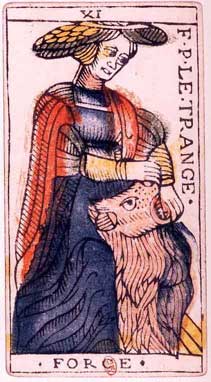
Jean Dodal, Lyon, 1701–1715
Marseille tradition · Image source

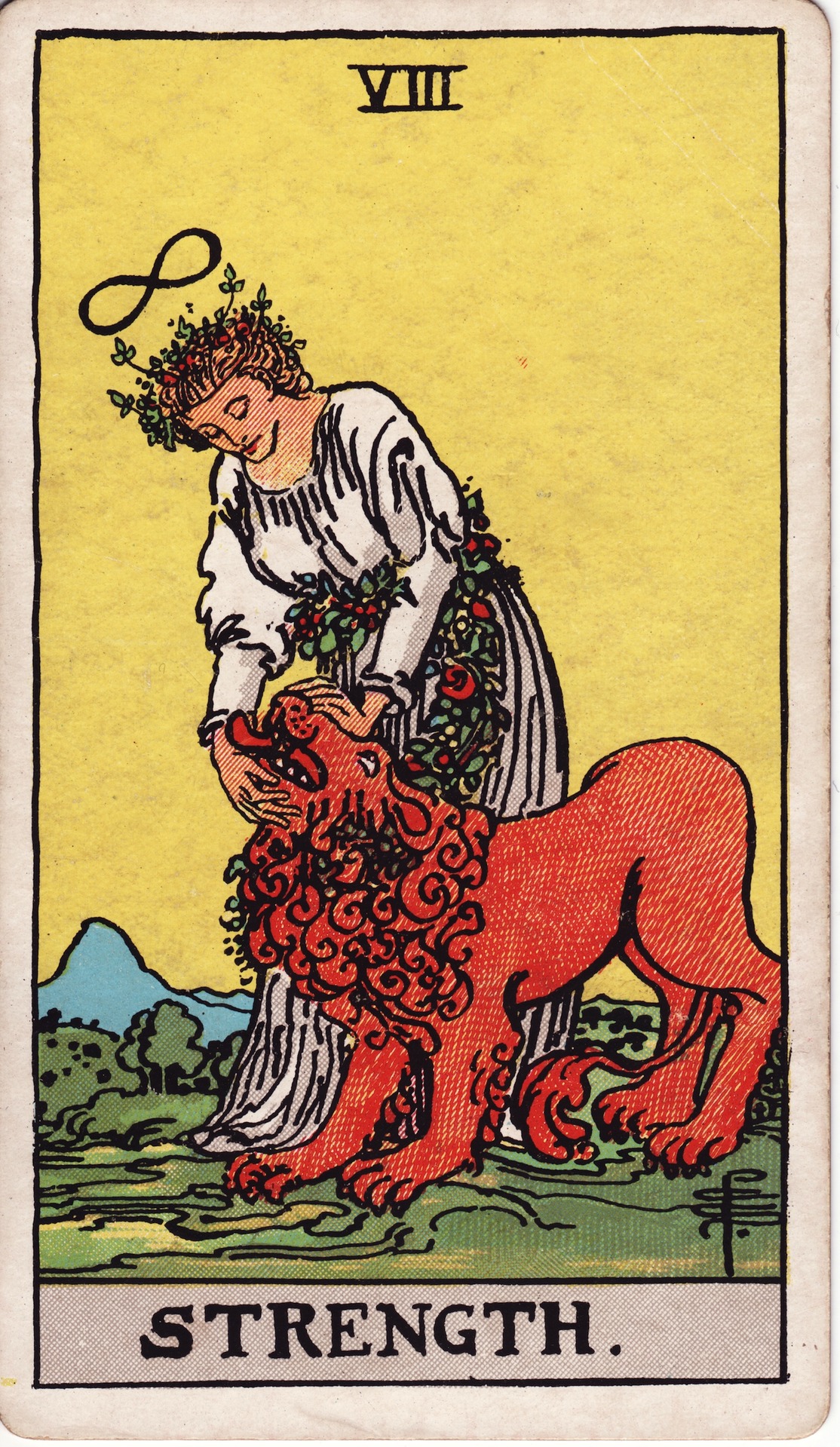
Pamela Colman Smith, 1910 card
Rider–Waite–Smith · Image source

The image on the right is a scan of an early card dated 1910; the deck first appeared in 1909. Select either picture to see it larger. Read about the numbering difference.
A timeline of tarot history
| Period | What changed |
|---|---|
| Early to mid-1400s | Tarot develops in Italy. Written references survive from the 1440s and 1450s, alongside early painted cards associated with the Visconti family. |
| 1491 | The Sola Busca deck uses figures and actions on its numbered suit cards. It is the earliest complete tarot deck known to survive. |
| 1600s–1700s | French workshops produce decks later grouped within the Tarot de Marseille tradition. |
| 1781 | Court de Gébelin publishes his claim that tarot preserves ancient Egyptian wisdom, influencing later occult writers. |
| Late 1700s | Etteilla and others publish reading methods and develop tarot decks intended for divination. |
| 1909 | The deck created by A. E. Waite and Pamela Colman Smith appears, now widely known as Rider–Waite–Smith. |
| 1900s to today | Thoth, themed decks and cross-cultural interpretations extend the tradition. Tarot continues in games, divination and art. |
The sections below explore these changes. Museum records, books and other references are collected at the end.
Tarot’s beginnings at the Italian card table
Early tarot added a special series of picture cards to a pack with four suits: cups, coins, swords and batons. The additional cards served as trumps in a trick-taking game, where players followed rules for playing cards and winning each round. That game structure is an important part of tarot’s origin.[1]
Among the most striking survivors are hand-painted cards associated with Milan’s Visconti family. Gold backgrounds, elaborate clothing and fine decoration make them resemble small paintings. Yale’s Visconti di Modrone deck dates to approximately 1440–45 and has 67 surviving cards.[2]
It includes female knights and pages, as well as Faith, Hope and Charity. Researchers suggest that the original pack may have contained at least 89 cards. The familiar 78-card structure cannot simply be projected onto every early deck.
Nor can the surviving evidence identify one person as tarot’s inventor. Its development belongs to Renaissance Italy, with gaps still remaining in the record of its earliest makers and players.
Tarot de Marseille: Images passed between workshops
As cards moved from painting to print, workshops in different cities produced their own versions. Tarot de Marseille now describes a family of related designs, recognizable through their figures, suits and arrangements.
The name can suggest that every example came from Marseille. Paris, Lyon and Avignon also belong to this history, and the category name itself came into use later. The Strength XI shown above was made by Jean Dodal in Lyon.[3]
One clear visual feature appears on the numbered suit cards: cups, swords, coins or batons are arranged according to their number, often with ornamental foliage. These pictures direct attention toward quantity, suit and composition. Most numbered cards in the later RWS deck instead include people in a setting.
New discoveries can still change the story. The Bibliothèque nationale de France holds a Philippe Vachier deck bearing the date 1639, adding evidence about early cardmaking in Marseille itself. A centuries-old pack can still bring something new to the table.
When did tarot become a divination tool?
In late-eighteenth-century France, card readers published methods while writers connected tarot with ancient wisdom, religion and occult ideas. These developments helped establish a divinatory tradition that could be taught and circulated in print.[5]
In 1781, Antoine Court de Gébelin argued in Le Monde primitif that tarot preserved ancient Egyptian knowledge. His account gave the cards an impressive distant ancestry and supplied later writers with a powerful starting point.[4]
There is no reliable historical evidence that tarot originated in ancient Egypt. Its early surviving cards and documents point to fifteenth-century Italy. The Egyptian claim belongs to tarot’s later interpretation history, helping explain the Egyptian gods, temples and symbols found in some subsequent decks.
Jean-Baptiste Alliette, writing as Etteilla, published card-reading methods and developed tarot packs for divination. Card order, names and meanings could now be reorganized around the needs of a reading.[5]
Meanwhile, the games continued. The French tarot federation still publishes rules for a multiplayer game using 78 cards. Tarot’s histories as a game and as a divination tool both remain alive.[18]
1909: Pamela Colman Smith’s familiar pictures
Many people first encounter tarot through the Rider–Waite–Smith deck, often shortened to RWS. Rider identifies the publisher, Waite the collaborator Arthur Edward Waite, and Smith the artist Pamela Colman Smith.
Waite commissioned Smith in 1909. She already worked in book illustration and theater design. Looking at the cards through that part of her career encourages us to notice how poses, distance and surroundings carry a story.[6]
Her contribution is especially clear in the numbered Minor Arcana. In the Ten of Wands, a figure bends beneath a bundle of ten staffs. In the Five of Cups, someone faces spilled cups while others remain standing behind them. Burden, loss and overlooked possibilities become things we can observe. Waite’s accompanying book explains that the pictures illustrate divinatory meanings while leaving room for intuition.[10]
For a beginner, that offers a starting point before every meaning has been memorized: describe who is doing what, what they notice and what lies outside their attention.
Scenic numbered cards had an earlier precedent, however. The Sola Busca tarot of 1491 already placed figures and actions on suit cards. Its complete set of 78 is held at the Pinacoteca di Brera in Milan.[7]
Smith helped make this visual approach enormously influential in modern tarot. Tarot42’s meanings also use Rider–Waite–Smith imagery as their basis. Remembering her name keeps the artist visible alongside the interpretations.
Why do decks have 22, 42, 78 or 97 cards?
A deck’s card count and its interpretive system are separate questions. Seventy-eight is the familiar full-deck total today, but history and publishing offer other configurations.
| Cards | What is included | How it differs |
|---|---|---|
| 22 | The Major Arcana alone, from the Fool to the World. | A group that can be used on its own, without the four Minor Arcana suits. |
| 42 | For example, 22 Majors, 16 court cards and four Aces. | A shortened pack omitting cards 2–10 in each suit: 36 cards in total. |
| 78 | 22 Majors and 56 Minors, with 14 cards in each of four suits. | The complete configuration used by Tarot42. |
| 97 | The Florentine Minchiate pack adds imagery including virtues, the elements and the zodiac signs. | A historical game tradition that developed alongside tarot, showing how packs could also grow. |
Waite’s card list documents the 78-card structure. A 42-card example survives in a university collection, and the V&A discusses Minchiate’s 97-card pack.[8][11][5]
The 22 Majors are often used to discuss significant changes, choices and life themes; the four Minor suits preserve further detail. Reading with the Majors alone or with a complete deck creates different possibilities. A smaller pack is not necessarily an older one.
For the related question of which card is “number 42,” continue with What Is Tarot Card 42? It explores different counting methods, actual 42-card decks and the story behind Tarot42’s name.
Marseille, RWS and Thoth: Three familiar traditions
A tarot “system” can refer to a particular deck, a visual tradition or a way of reading. It helps to say which of these you are comparing.
| Tradition | Visible characteristics | What to keep in mind |
|---|---|---|
| Tarot de Marseille | Traditional figures; numbered suit cards usually emphasize repeated suit symbols and ornament. | A family of cardmakers’ versions, with differences between examples. |
| Rider–Waite–Smith | Most numbered Minor cards show figures within complete scenes. | Modern redrawings often retain the compositions, even when the artistic style changes. |
| Thoth | A collaboration between Aleister Crowley and painter Frieda Harris, using astrological, Qabalistic and alchemical correspondences. | Its names and interpretations should be read with that particular deck’s explanations. |
The Thoth publisher identifies both creators and the traditions brought into the deck. Like Smith, Harris deserves to be remembered as an artist.[12]
These three traditions are useful points of orientation. Regional playing-card packs, historical variants and contemporary independent decks make the wider map much larger.
How tarot meets astrology, Indian traditions and other practices
A card showing the Sun, Moon or stars naturally suggests the sky. Depicting a celestial object and assigning each card a detailed astrological correspondence are different kinds of design.
Astrology, Kabbalah and alchemy
Some occult systems interpret tarot alongside planets, zodiac signs, elements, Hebrew letters and the Qabalistic Tree of Life. Thoth provides a clear example: its publisher explicitly describes astrology, Qabalah and alchemy as part of its symbolic framework. These correspondences make sense within their particular system.[12]
The Florentine Minchiate tradition had already brought zodiac signs and elements into card packs in the sixteenth century. Astrological subjects in cards therefore predate familiar modern divination decks. Game imagery, occult correspondences and present-day reading practices each have their own development.[5]
Indian astrology and tarot: Concrete examples of a meeting
Indian astrology is often called Jyotish. Today, some card sets teach it, while other creators combine Indian traditions with tarot’s structure. A deck’s actual contents are more informative than the word “Vedic” on a box.
One particularly interesting example dates to 1990. The Indira Gandhi National Centre for the Arts records an astro-mythological pack conceived by Gordhandas and hand-painted in Sawantwadi. It keeps 22 major cards and 56 minor cards, incorporating planetary and zodiac deities and suits associated with Vishnu, Brahma, Shiva and Indra.[13]
A detailed photographic record shows the 22-card group arranged around nine astrological planetary subjects, twelve zodiac subjects and a special card. A familiar total becomes a way to organize another cultural story.[14]
Dwina Murphy-Gibb’s modern The Vedic Tarot takes another approach. Its publisher presents an 81-card synthesis involving Sanskrit, Hebrew and Ogham, chakras, and Eastern and Western astrology. Three additional cards belong to the author’s design.[15]
Jeffrey Armstrong’s Vedic Astrology Deck, meanwhile, is a 44-card learning set focused on Jyotish. It has a related subject but a different structure from tarot’s 22-plus-56 arrangement. Cards with similar themes may be different kinds of decks.[16]
These examples document particular cross-cultural creations. They do not relocate the origins of fifteenth-century Italian tarot to ancient India.
Crystals, themed images and personal practice
Readers today may pair tarot with crystals, plants or personal rituals. With such combinations, it helps to understand how an author connects meanings, colors or symbolic associations.
Tarot42’s guide to tarot cards and crystals offers one place to continue. You can explore the associations and make your own choices; they need not be identical in every deck or period.
Historical details you can still see on the cards
Why do Strength and Justice change numbers?
Return to the two cards at the top: Dodal’s Strength is XI and the RWS version is VIII. They follow different arrangements.
| Card | Marseille | RWS |
|---|---|---|
| Justice | VIII, 8 | XI, 11 |
| Strength | XI, 11 | VIII, 8 |
In The Pictorial Key to the Tarot, Waite explicitly says that he exchanged Strength and Justice, without expanding on his reasons in that passage. Checking a deck’s own system is therefore a good first step when the numbers differ.[9]
You can also compare Strength and Justice through their pictures: the relationship with the lion, the scales and the sword offer ways into the cards beyond their numbers.
From the Popess to the High Priestess
In the Marseille tradition, La Papesse is the Popess. In RWS, the card is the High Priestess, seated between pillars with a scroll and a crescent Moon. Name and image together guide attention toward knowledge, mysteries and religious symbolism. Waite discusses the card’s alternative names in his book.[8][9]
The two titles often identify different historical expressions of a corresponding card. A name can itself be a clue when comparing decks.
Why is the Fool numbered 0?
The RWS Fool is 0, while some traditional decks leave the card unnumbered. Its position within the sequence has also varied.[19][9]
Games offer another perspective. In modern French tarot, the corresponding special card is l’Excuse, which can excuse its player from following the suit or playing a trump.[18]
Modern readings about beginnings, freedom or setting out on a journey offer one approach to the Fool. Its game role reveals another part of this unusual card’s history.
A few more unexpected facts about tarot
A tarot deck can advertise paper
In 1967, Brown Company made the 42-card Linweave Tarot to demonstrate papers in different colors, textures and weights. The backs combined divinatory meanings, artists’ names, paper details and advertisements. An example is preserved at Johns Hopkins University.[11]
A little insight into your future, a little insight into paper. At least the paper came with specifications. For its exact card count, see the section on real 42-card decks.
The “Charles VI tarot” carries a mistaken identity
A set of painted cards long called the Charles VI tarot sounds as though it belonged to the French king. The BnF explains that the name arose from a mistaken connection with a 1392 payment for playing cards. Its 17 surviving cards date to around 1460 and were probably made in Florence. Even an established name can need checking.[17]
The Popess and Pope can become Roman deities
In the Swiss 1JJ tradition, cards II and V depict Juno and Jupiter in place of the Popess and Pope. The pack is also used for Swiss tarot games. To identify a deck, look at who occupies those positions as well as how many cards it contains.[20]
Indian zodiac cards have histories of their own
India has its Ganjifa playing-card traditions. The Indira Gandhi National Centre for the Arts records Rashi zodiac packs, including examples with 12 suits and 144 cards. Similar subjects can appear in different card traditions; their rules, makers and provenance help us understand each one.[13]
Questions about tarot’s history
How old are tarot cards?
The early cards and documents place tarot in fifteenth-century Italy, giving it roughly six hundred years of history. Familiar divinatory systems developed later.
What is the oldest tarot deck?
Distinguish the earliest surviving cards from the earliest complete pack. Mid-fifteenth-century Visconti-related cards belong to the former group. Brera identifies the Sola Busca of 1491 as the oldest surviving complete tarot deck.[2][7]
Can you read tarot with just 22 cards?
You can use the Major Arcana alone. That keeps the figures from the Fool to the World while leaving out 56 Minor cards. The choice depends on your pack and reading method.
Does an Indian astrology theme make tarot Indian in origin?
Theme, structure and date of creation need to be considered separately. Modern fusion decks have their own creative value; early origins should be traced through early records and objects.
References and image credits
These sources support the dates, objects and deck descriptions. Museum and library records inform the historical sections; publishers’ descriptions explain the aims of contemporary designs.
- The Metropolitan Museum of Art: Before Fortune-Telling
Early Italian tarot, game structure and surviving decks. - Yale Library: Researching the Visconti deck
The deck dated c. 1440–45, its 67 surviving cards and a proposed original total of at least 89. - Bibliothèque nationale de France: Un tarot qui rebat les cartes
The Marseille tradition and the Vachier deck dated 1639. - The Morgan Library & Museum: Occult Tarot
The Egyptian-origin claim published in 1781 and later occult interpretations. - V&A: A history of tarot cards
Divination, Etteilla and the 97-card Minchiate. - The Morgan Library & Museum: Pamela Colman Smith before Waite
Smith’s artistic work and her commission in 1909. - Pinacoteca di Brera: The Sola Busca Deck and the Tarot Game
The 1491 deck and its complete set of 78 cards. - A. E. Waite: The Pictorial Key to the Tarot, Part I
Deck structure, card names and Waite’s own explanations. - A. E. Waite: The Pictorial Key to the Tarot, Part II
Strength and Justice numbering, the High Priestess and the Fool. - A. E. Waite: The Pictorial Key to the Tarot, Part III
Minor Arcana pictures and their divinatory meanings. - Johns Hopkins University: Brown Company Linweave tarot deck, 1967
The 42-card deck, paper samples and advertisements on the backs. - U.S. Games: Pocket Swiss Crowley Thoth Tarot
The creators and the symbolic systems used in the Thoth deck. - Indira Gandhi National Centre for the Arts: Ganjifa Cards
Rashi decks in entries 60–61 and the 1990 astro-mythological deck in entry 110. - The World of Playing Cards: Hindu Astro-Mythological Tarot
Images and the detailed structure of the 1990 deck. - Schiffer Publishing: The Vedic Tarot
The author’s 81-card design and its combination of Eastern and Western traditions. - Insight Editions: Vedic Astrology Deck
A 44-card learning deck based on Jyotish. - Bibliothèque nationale de France: Tarot dit de Charles VI
The 17 surviving cards, their date around 1460 and the mistaken attribution. - Fédération française de tarot: Official rules
Modern French tarot and the special role of l’Excuse. - The Fitzwilliam Museum: An unnumbered Le Mat
A surviving example of an unnumbered Fool in a Marseille deck. - Pagat: Troggu rules
Juno and Jupiter in the Swiss 1JJ tradition.
Image 1: Jean Dodal, Strength XI, 1701–1715, via Wikimedia Commons; the source marks the work PD-Art. Image 2: Pamela Colman Smith, Strength VIII, an early card scan dated 1910 on the source page and marked with the Public Domain Mark.