
The Fool’s Journey at a glance
What is the Fool’s Journey in tarot?
The Fool’s Journey is a storytelling approach to the 22 Major Arcana: the Fool, numbered 0, moves through experiences associated with the Magician, the High Priestess, and the remaining cards until the World, XXI. It helps beginners remember how the cards relate, rather than memorizing 22 isolated definitions.
If you searched for a tarot cards story, this is one useful place to begin. The larger themes are curiosity, choice, effort, uncertainty, change, and integration. A person can revisit any of them many times; the cards do not prescribe an age, a deadline, or a compulsory sequence of life events.
Tarot cards first appeared in fifteenth-century northern Italy as playing cards. Reading the Major Arcana as a personal journey is a later interpretive approach, not proof of an ancient, fixed plot hidden in the first decks.
Read the history of tarot cards
The tale below is our original fictional retelling, not a translation of another author’s story. Its three stages are a reading aid. We follow the numbering used in Rider–Waite–Smith imagery: Strength VIII and Justice XI; some other decks reverse those positions.
Stage one · Learning to enter the world
0–VII. Before the traveler can find a direction, they need tools, attention, care, boundaries, shared knowledge, and a choice that is their own.
0 · The Fool
A beginning without a complete map
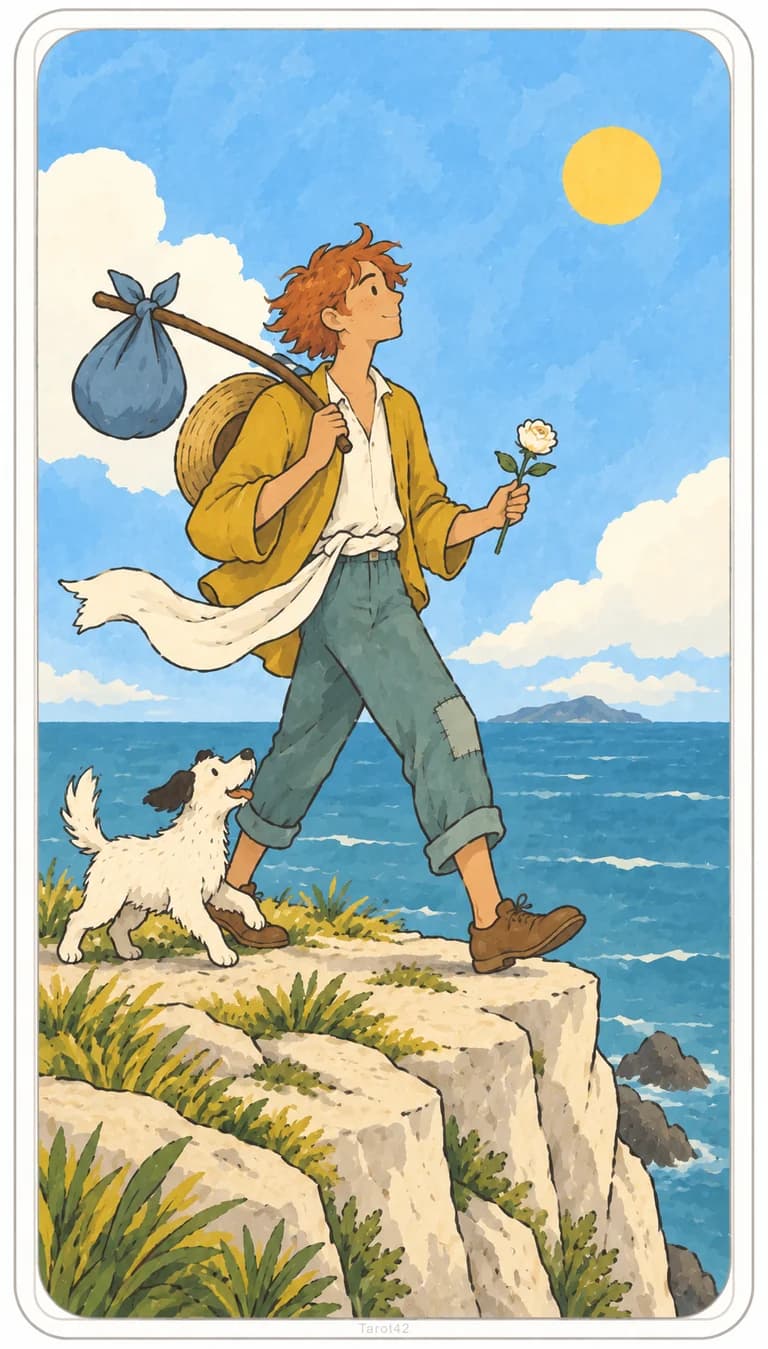
The traveler leaves before the village is fully awake. In the bundle are a change of clothes, a crust of bread, and several confident ideas about the world. The little dog notices the rough edge of the path before the traveler does. Curiosity has started the journey; paying attention will keep it possible.
Nothing here requires a reckless leap. The first adventure may be as small as showing someone a sketch, learning a language, or admitting that an old plan no longer fits.
The card’s lesson: The Fool brings openness, possibility, and beginner’s trust. The small bundle suggests traveling lightly, while the dog adds alertness to the excitement of setting out.
A question to carry: What could I begin before I feel completely ready?
Explore this card’s meanings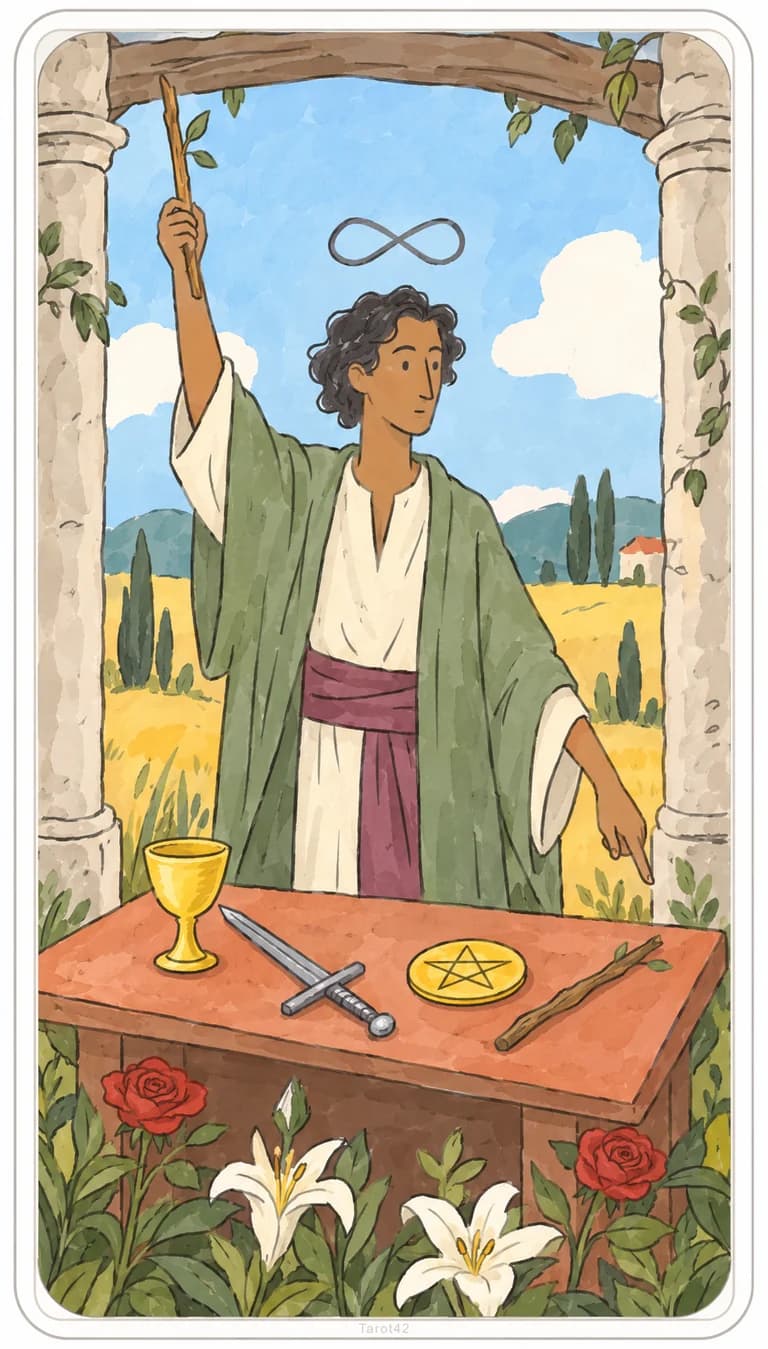
I · The Magician
The tools are already on the table
At a roadside workshop, a maker asks what the traveler can do. The answer starts with a list of things they lack. The maker quietly lays out a cup, a blade, a branch, and a coin, then points toward a half-repaired chair. The traveler has hands, time, attention, and someone willing to teach.
By evening the chair stands. It is imperfect, but it holds a person’s weight. For the first time, an intention has become something another person can use.
The card’s lesson: The Magician connects intention with available resources and skill. The four objects on the table gather different kinds of potential into one deliberate act.
A question to carry: Which resource could I put to use today?
Explore this card’s meanings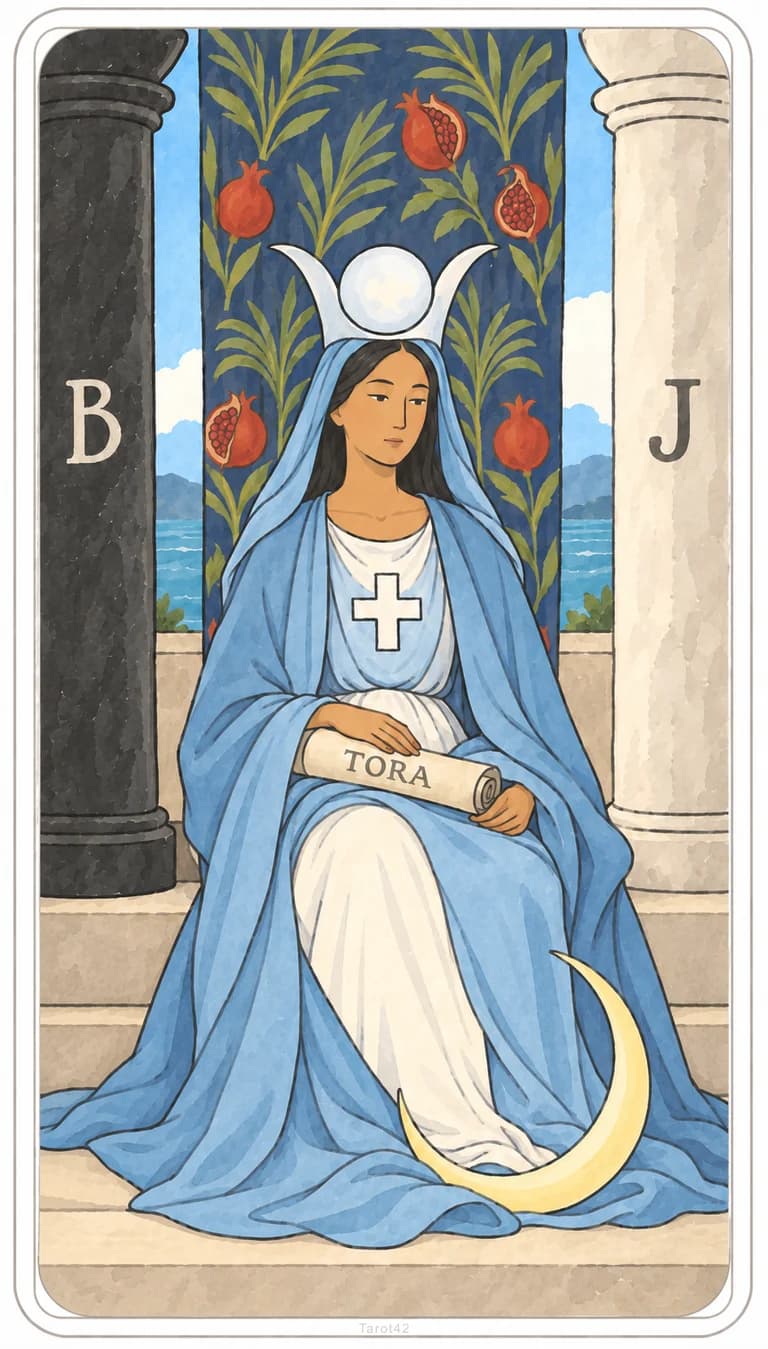
II · The High Priestess
Not every answer arrives as an instruction
The next doorway is quiet. A keeper of records listens while the traveler asks which road is best. She does not choose for them. She asks why one destination keeps appearing in their dreams, and why they rush past the thought whenever it returns.
The traveler sits long enough to notice an answer beneath the rehearsed one. It is not complete information. It is something worth investigating without immediately explaining it away.
The card’s lesson: The High Priestess suggests receptivity, intuition, and what remains unknown. Her quiet presence creates room to notice what an immediate answer might overlook.
A question to carry: What have I noticed but not yet allowed myself to consider?
Explore this card’s meanings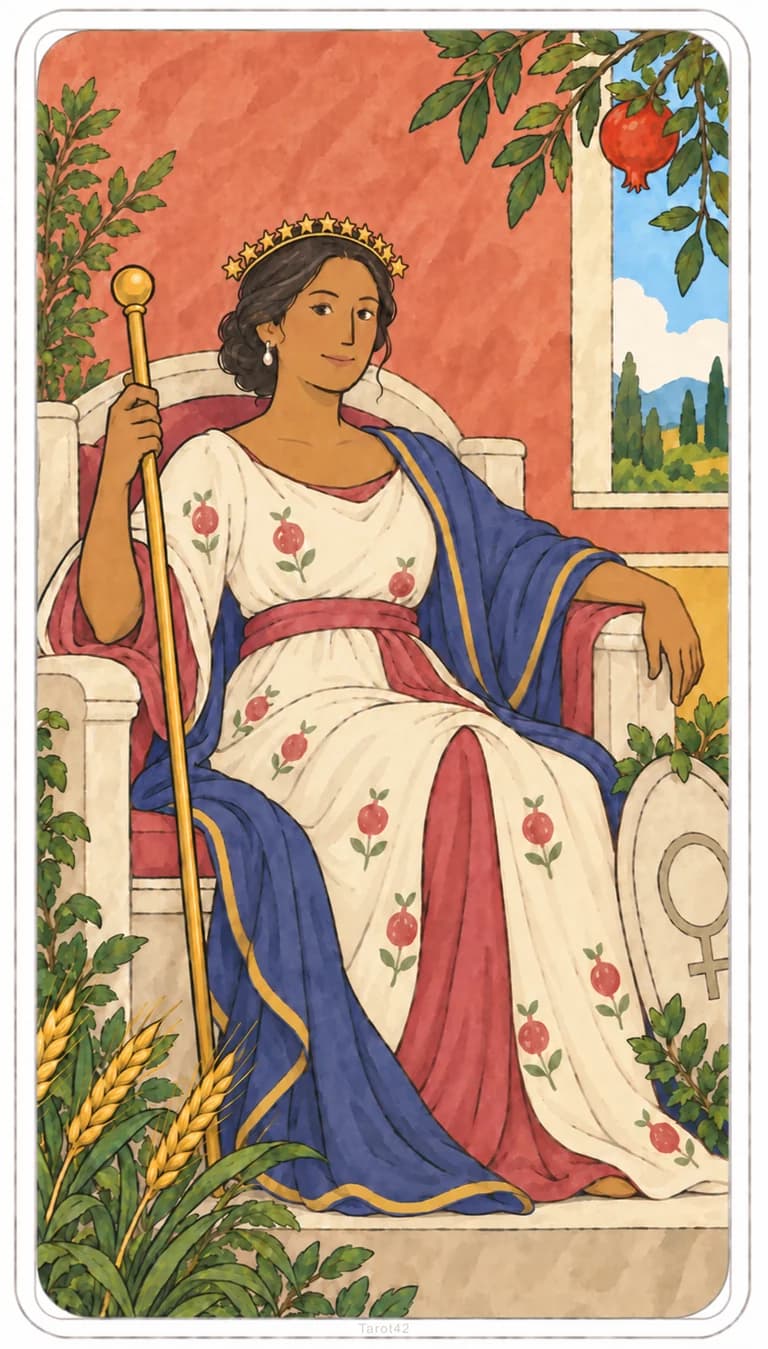
III · The Empress
Growth needs somewhere to take root
In an orchard, a host offers a meal before asking where the traveler has been. The trees are heavy with fruit because someone watered them months before any visitor could see a result. The traveler is invited to help loosen the soil around a young tree.
Care turns out to be work with a generous rhythm: food, rest, room, repetition. The traveler begins to treat their own unfinished work as something living, rather than something to force into shape.
The card’s lesson: The Empress concerns nourishment, creativity, the senses, and conditions that support growth. Her abundant surroundings connect creative possibility with the patient care that helps it flourish.
A question to carry: What would help this part of my life grow well?
Explore this card’s meanings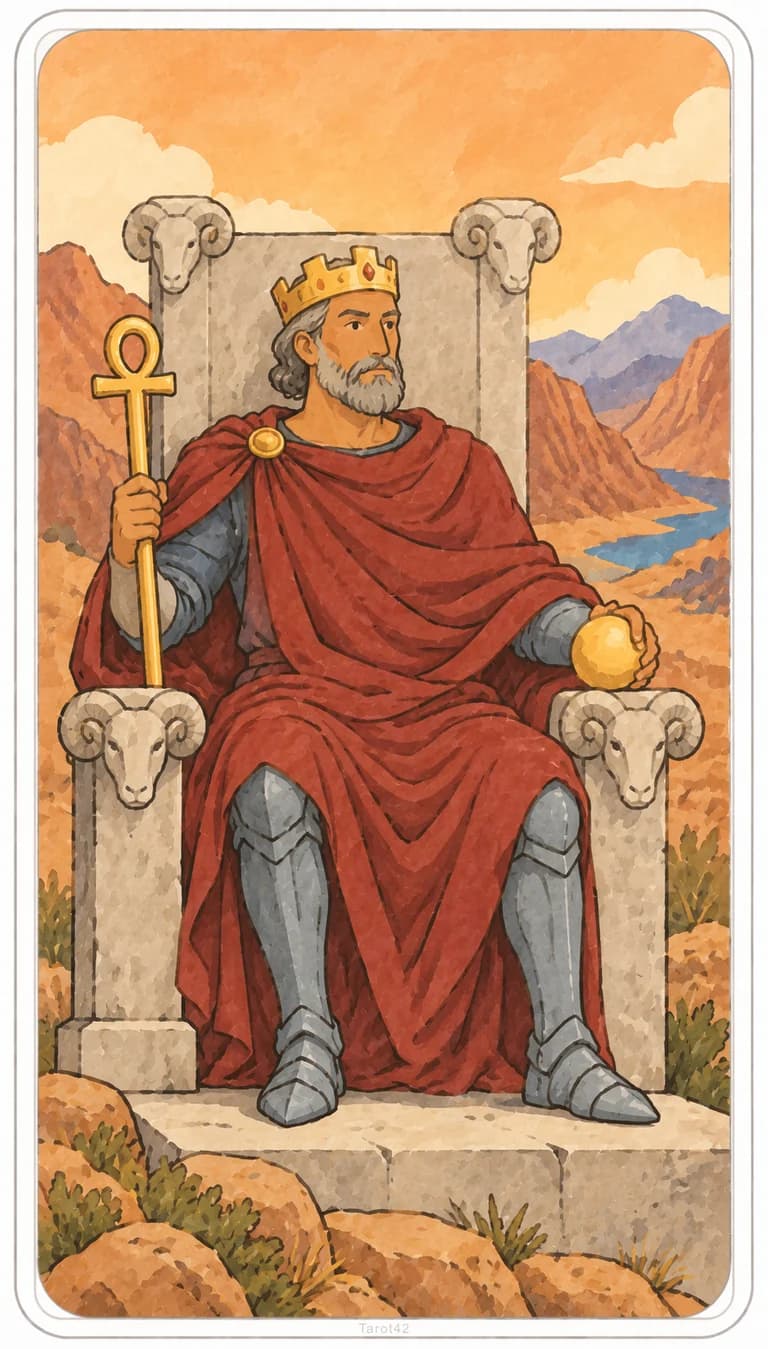
IV · The Emperor
A boundary can make a shelter
A storm reaches the valley. At a settlement, the traveler watches a leader assign repairs, reserve drinking water, and close a damaged bridge. The rules initially feel like obstacles. Then the traveler sees children sleeping safely inside the rooms those rules protect.
When asked to lead a small repair, they discover that authority includes saying what can be done and what cannot. A clear promise is more useful than an impressive one.
The card’s lesson: The Emperor represents structure, responsibility, and boundaries. Useful order supports life; control becomes restrictive when protecting authority matters more than protecting people.
A question to carry: Which boundary would make my commitments more reliable?
Explore this card’s meanings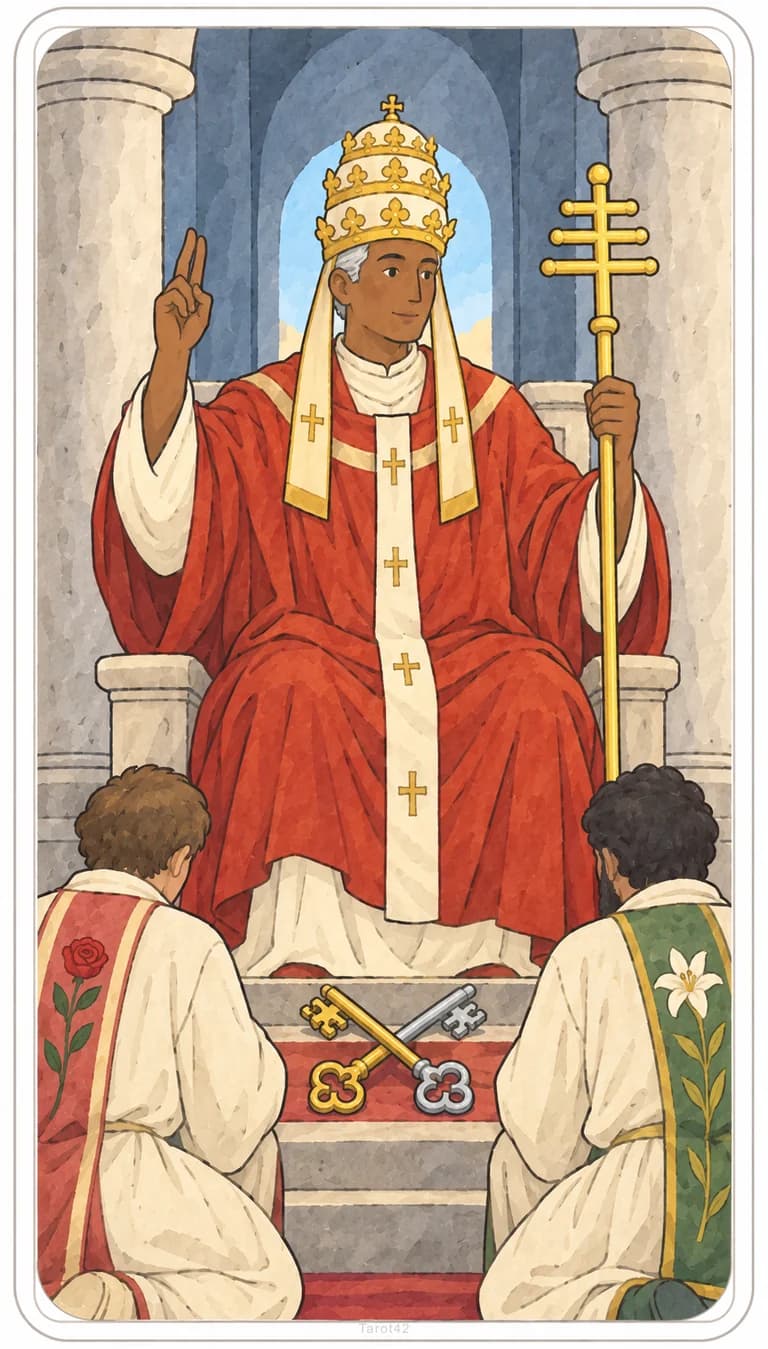
V · The Hierophant
Learning what a community passes on
In the next town, an experienced teacher shows apprentices a familiar technique. Its steps feel slow until the traveler sees the mistakes each step prevents. Much of what looked like ritual is accumulated attention, passed from hand to hand.
Still, one custom seems unfair. The teacher welcomes the question rather than demanding silence. The traveler learns to distinguish respect for knowledge from obedience that no longer allows anyone to think.
The card’s lesson: The Hierophant points toward tradition, institutions, teaching, and shared values. It invites a conscious relationship with inherited knowledge, including decisions about what deserves to be retained.
A question to carry: Which teaching supports me, and which assumption needs a question?
Explore this card’s meanings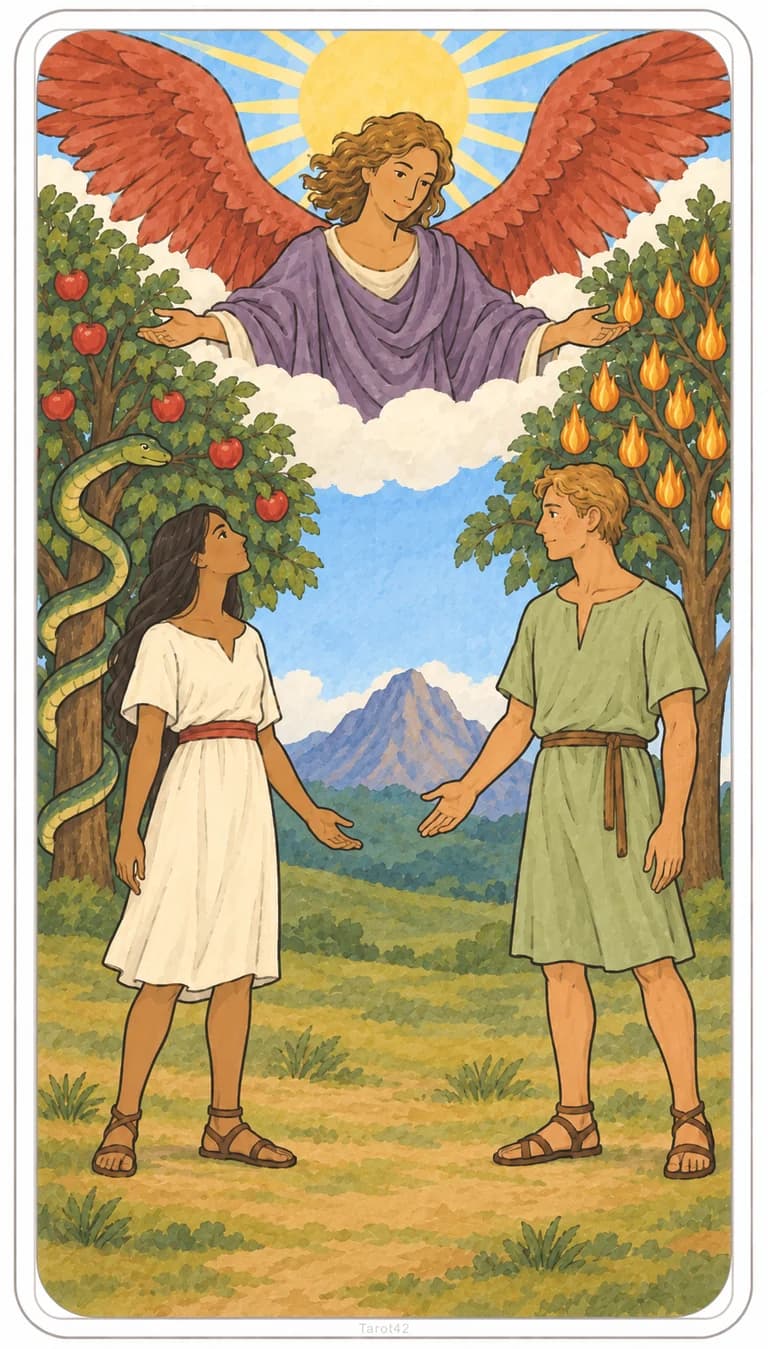
VI · The Lovers
Choosing what the journey is for
The traveler is offered a position that would bring approval and a comfortable room. Someone they care about offers a different possibility: building a life together, with fewer guarantees and more honest conversation. Neither choice is answered by attraction alone.
For the first time, the traveler names the values they do not want to trade away. Affection becomes more serious when both people can hear a real yes, a real no, and the reasons beneath them.
The card’s lesson: The Lovers concerns relationship, alignment, and meaningful choice. Romance is one expression; the wider question is whether a decision agrees with one’s values and responsibilities.
A question to carry: What choice would let my actions agree with what I value?
Explore this card’s meanings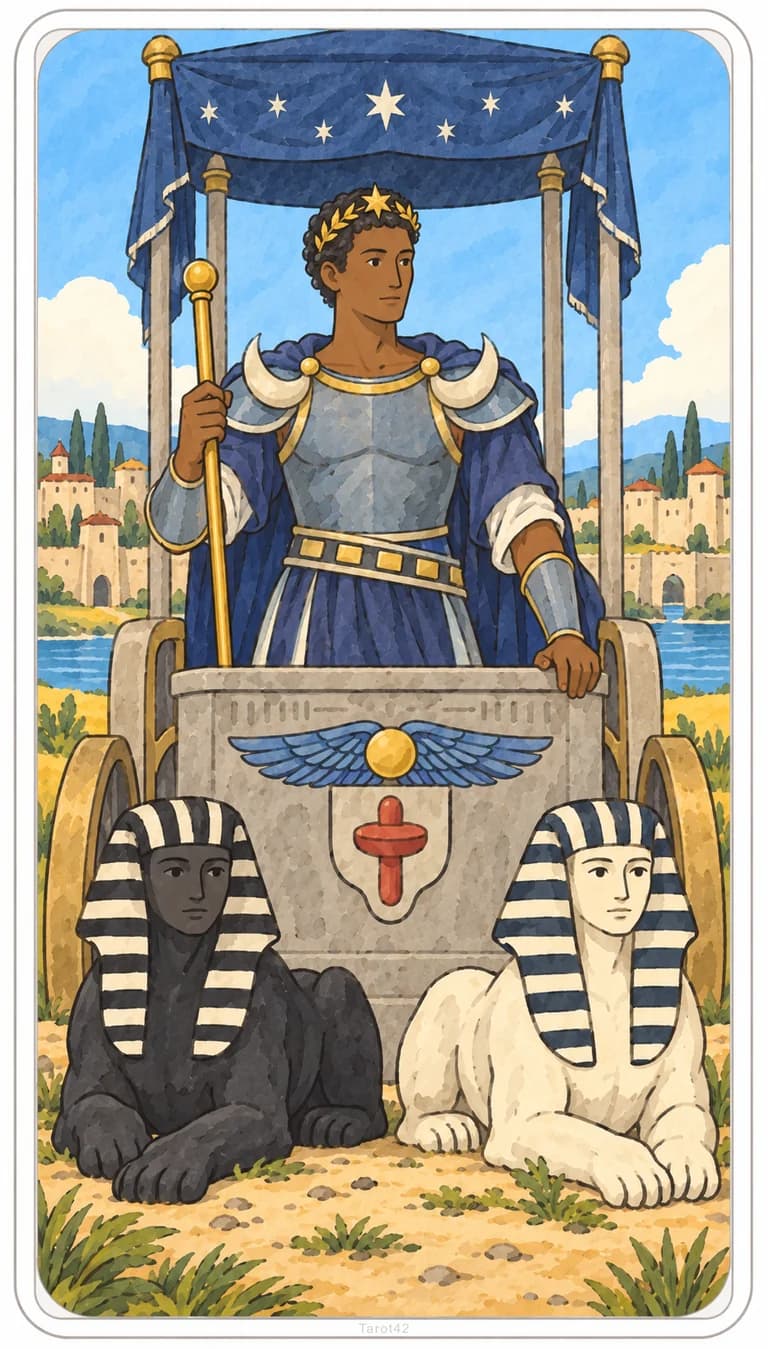
VII · The Chariot
Taking a direction without controlling everything
With a decision made, the traveler loads a cart. Its two strong creatures lean in different directions: one wants the familiar road, the other the shortest one. Pulling harder at random exhausts everyone. The traveler has to set a course and keep responding to the ground.
The day ends farther from home than any before it. That progress comes from attention and commitment, not from eliminating every conflicting feeling.
The card’s lesson: The Chariot brings determination, coordinated effort, and direction. The contrasting figures before the chariot make an image of gathering different drives into a common purpose.
A question to carry: Which direction deserves sustained effort now?
Explore this card’s meaningsStage two · Learning to change within
VIII–XIV. Moving forward is no longer enough. The traveler encounters fear, solitude, consequences, and the limits of their old way of seeing.
VIII · Strength
A gentler kind of courage
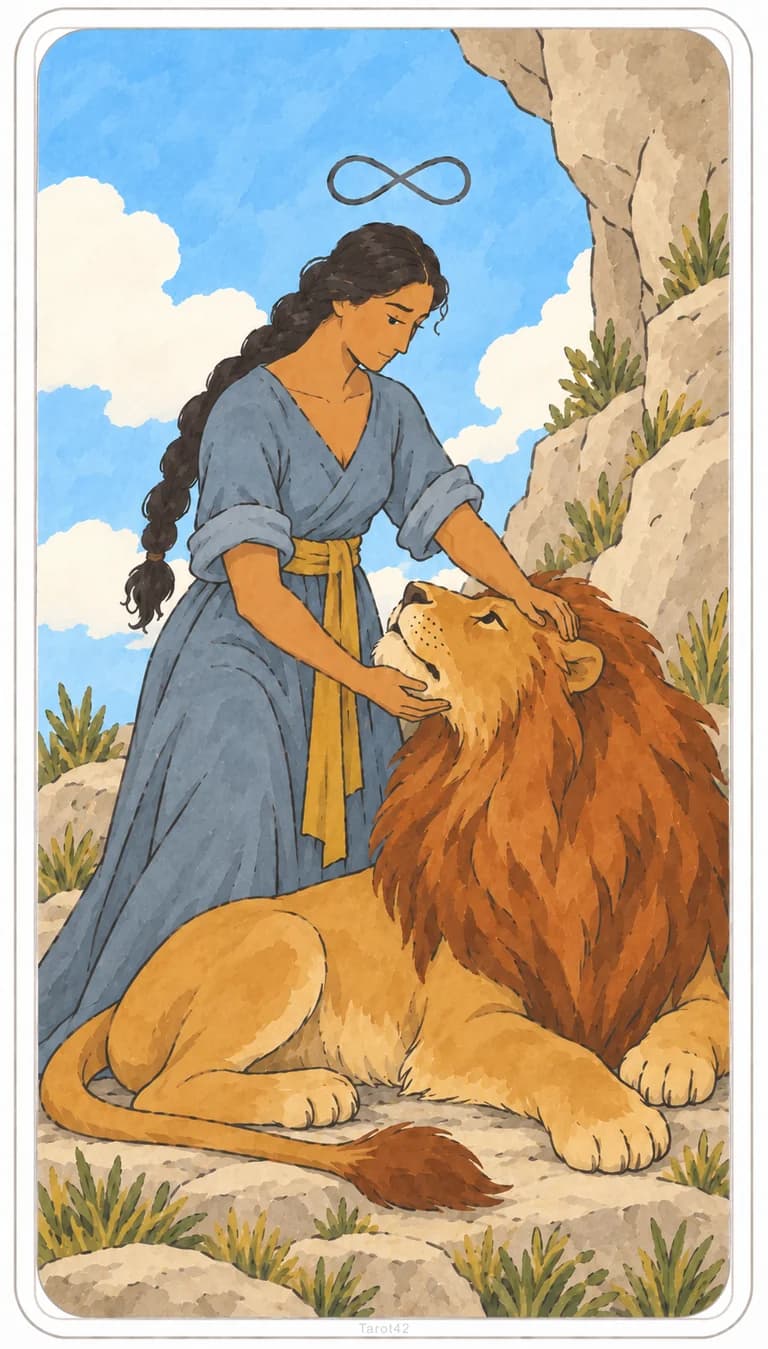
At a narrow passage, the traveler encounters a frightened lion. Shouting makes it more agitated. They stop, lower their voice, and give the animal space. Their own hands are shaking too; courage has not removed fear.
The encounter changes what strength looks like. The traveler can take their fear seriously without letting it make every decision, and can set a boundary without turning it into a battle.
The card’s lesson: Strength represents patient courage, self-command, and compassion. The woman’s gentle contact with the lion makes inner steadiness visible through a relationship with powerful instincts.
A question to carry: Where could steadiness help more than force?
Explore this card’s meanings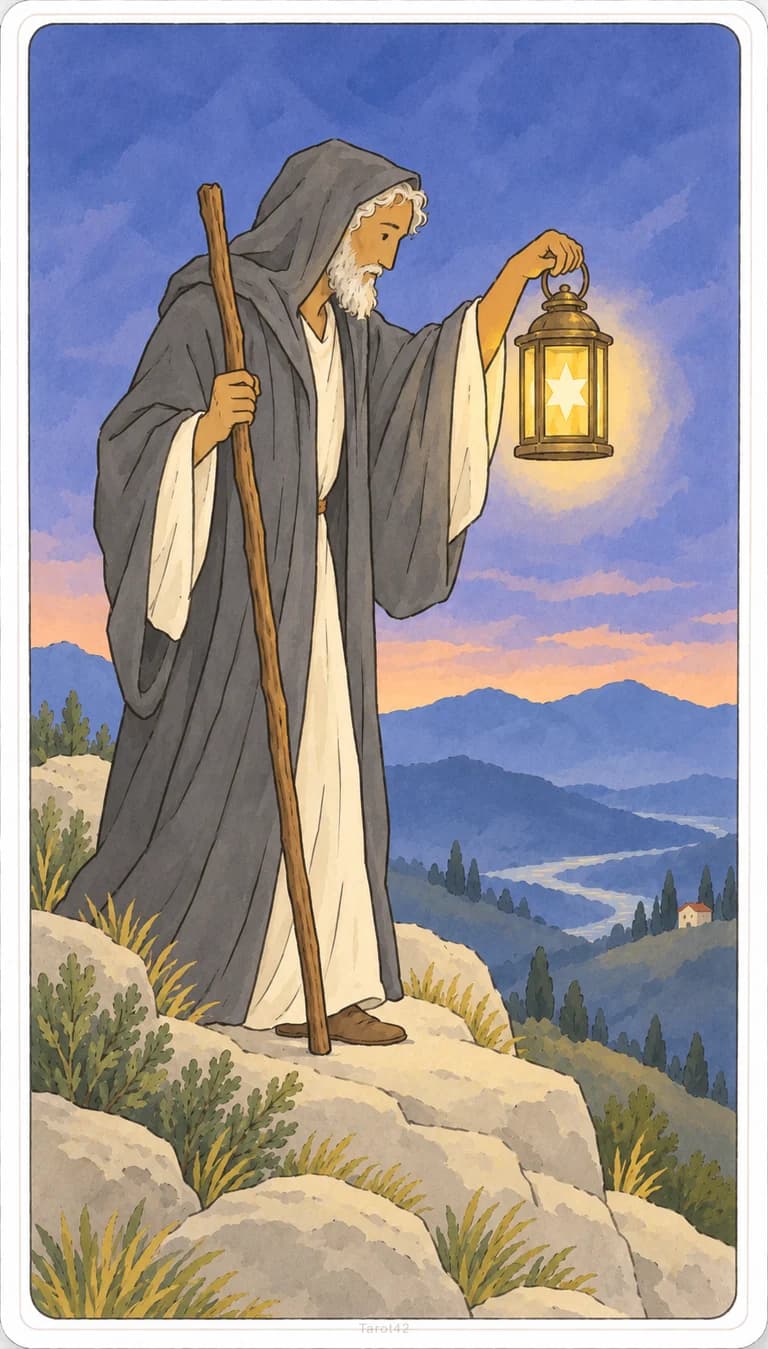
IX · The Hermit
A light small enough to carry
After months of other people’s advice, the traveler climbs a quiet ridge alone. An older walker carries a lantern that lights only a few stones at a time. Asked about the distant pass, the walker smiles: the lantern is for the next step.
The silence is not a punishment. It gives the traveler room to hear which desires are theirs, and which were borrowed from an audience they are no longer standing before.
The card’s lesson: The Hermit suggests reflection, solitude, and the search for a considered truth. His raised lantern offers a modest circle of light: enough to examine the next step carefully.
A question to carry: What becomes clearer when I step away from the noise?
Explore this card’s meanings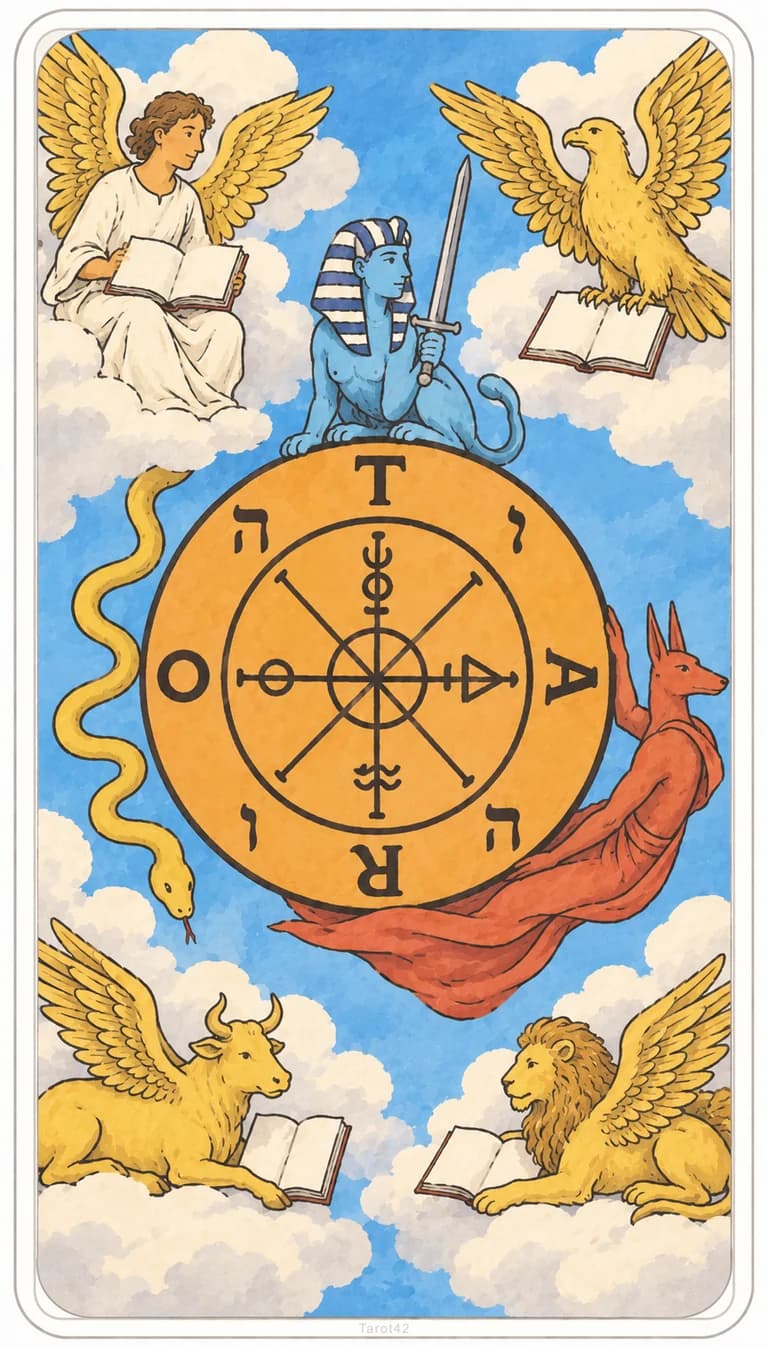
X · Wheel of Fortune
The road changes without asking
The pass closes after heavy rain. A promised job disappears with it. The traveler first treats the delay as a personal verdict, then meets other people rearranging equally careful plans. Weather, timing, and the wider world have entered the story.
A chance conversation reveals another route. It does not erase the disappointment. It does remind the traveler that a turn in circumstances is not the same thing as a final definition of their worth.
The card’s lesson: The Wheel of Fortune concerns cycles, changing circumstances, and the limits of control. Its turning image puts individual effort inside a wider world of timing, chance, and change.
A question to carry: What can I influence inside this change, and what must I work around?
Explore this card’s meanings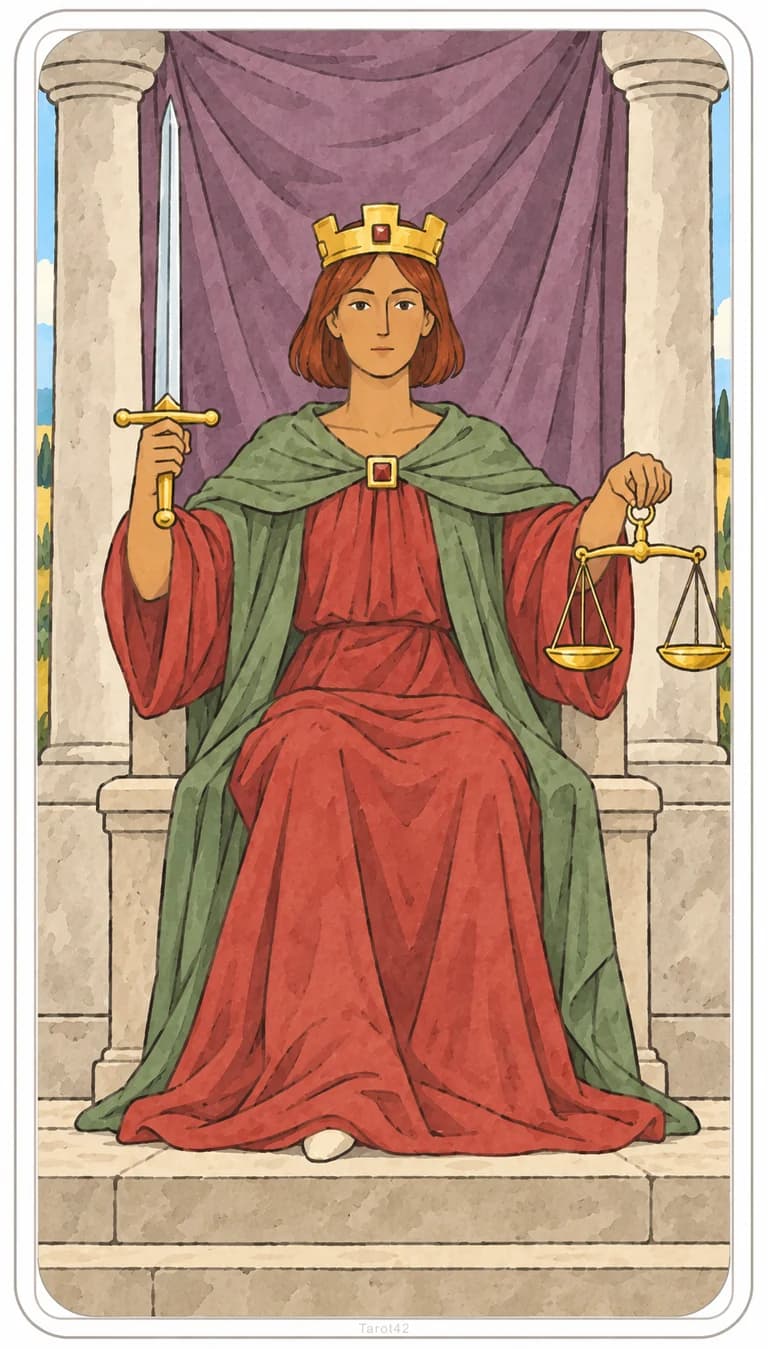
XI · Justice
Looking plainly at the consequences
In a town dispute, the traveler is sure they have been treated unfairly. Asked to describe the whole sequence, they remember a promise they changed without telling anyone. Another person’s mistake remains real, but it is no longer the only fact.
They listen, correct their account, and agree to repair what is theirs to repair. Fairness becomes less like winning the argument and more like making the record honest.
The card’s lesson: Justice asks for truthfulness, proportion, decisions, and accountability. Her scales invite a fair weighing of facts, while her sword gives the resulting decision a clear edge.
A question to carry: What fact, responsibility, or other person’s perspective have I left out?
Explore this card’s meanings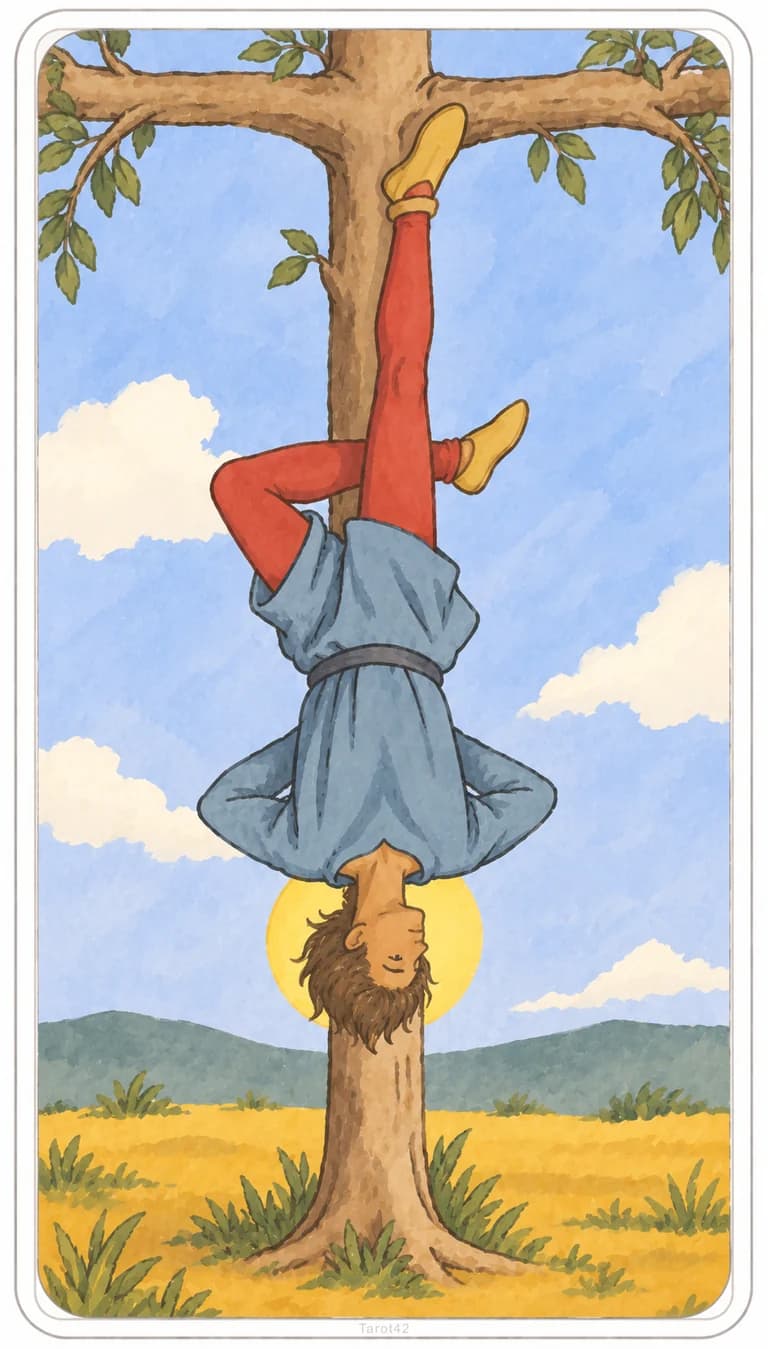
XII · The Hanged Man
The pause that changes the view
Every route the traveler tries reaches the same locked gate. More effort produces a more elaborate version of the same frustration. Unable to go forward, they stop insisting that forward is the only useful direction.
From a different vantage point, they notice a side entrance used by the people who maintain the walls. The pause has not solved everything. It has loosened the assumption that kept the entrance invisible.
The card’s lesson: The Hanged Man represents suspension, changed perspective, and surrendering an unhelpful demand for control. The stillness of the figure turns an interruption into a chance to see differently.
A question to carry: What might I see if I stopped forcing this particular answer?
Explore this card’s meanings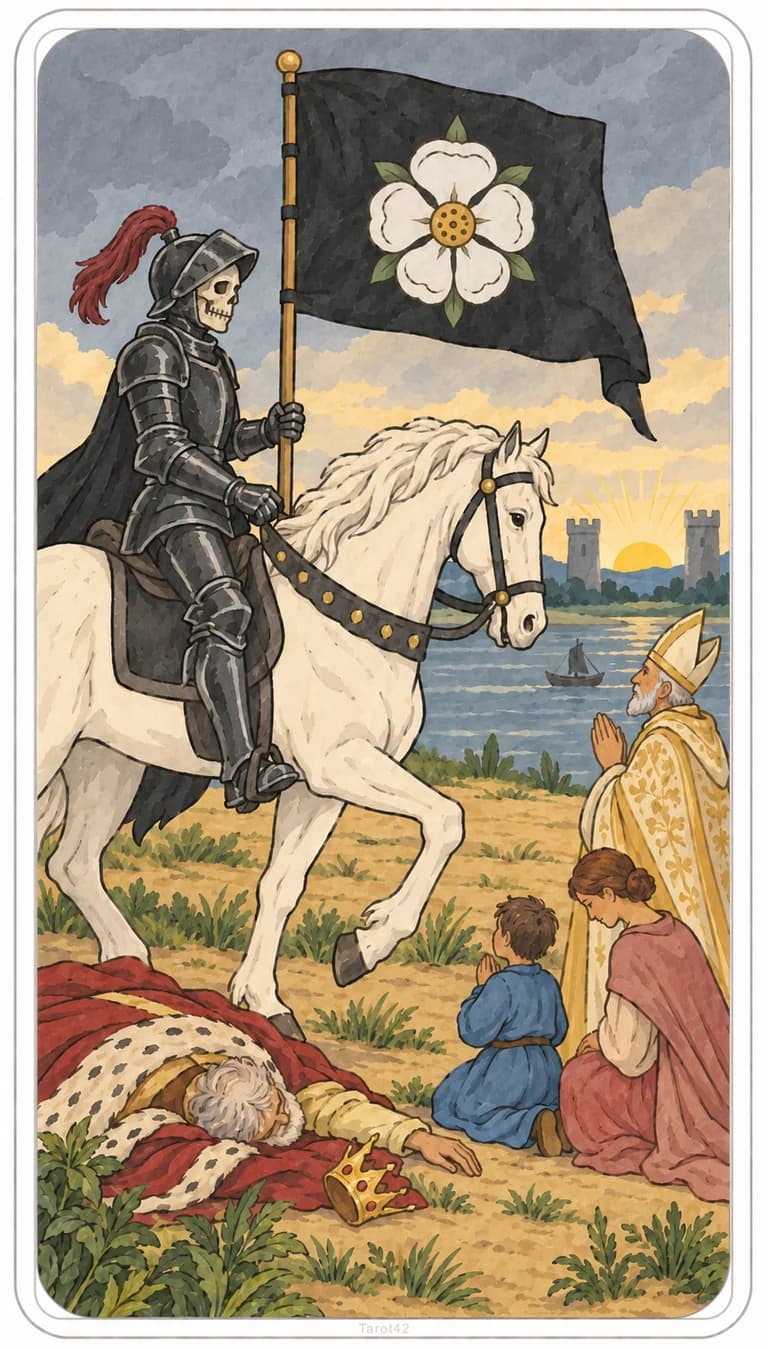
XIII · Death
An ending deserves to be acknowledged
The traveler returns to an old workshop and finds it closed. For days they imagine how it might be restored exactly as it was. Then a former apprentice explains that the work has moved elsewhere; the old room has served its time.
They take one useful tool, thank the people who taught them, and leave the key. Grief and relief can share a doorway. Moving on does not require pretending that nothing valuable was lost.
The card’s lesson: Death commonly signifies an ending, transition, and the release of an outgrown form. The moving rider and the light beyond the scene hold closure and continuing life in the same image.
A question to carry: What ending am I still trying to postpone naming?
Explore this card’s meanings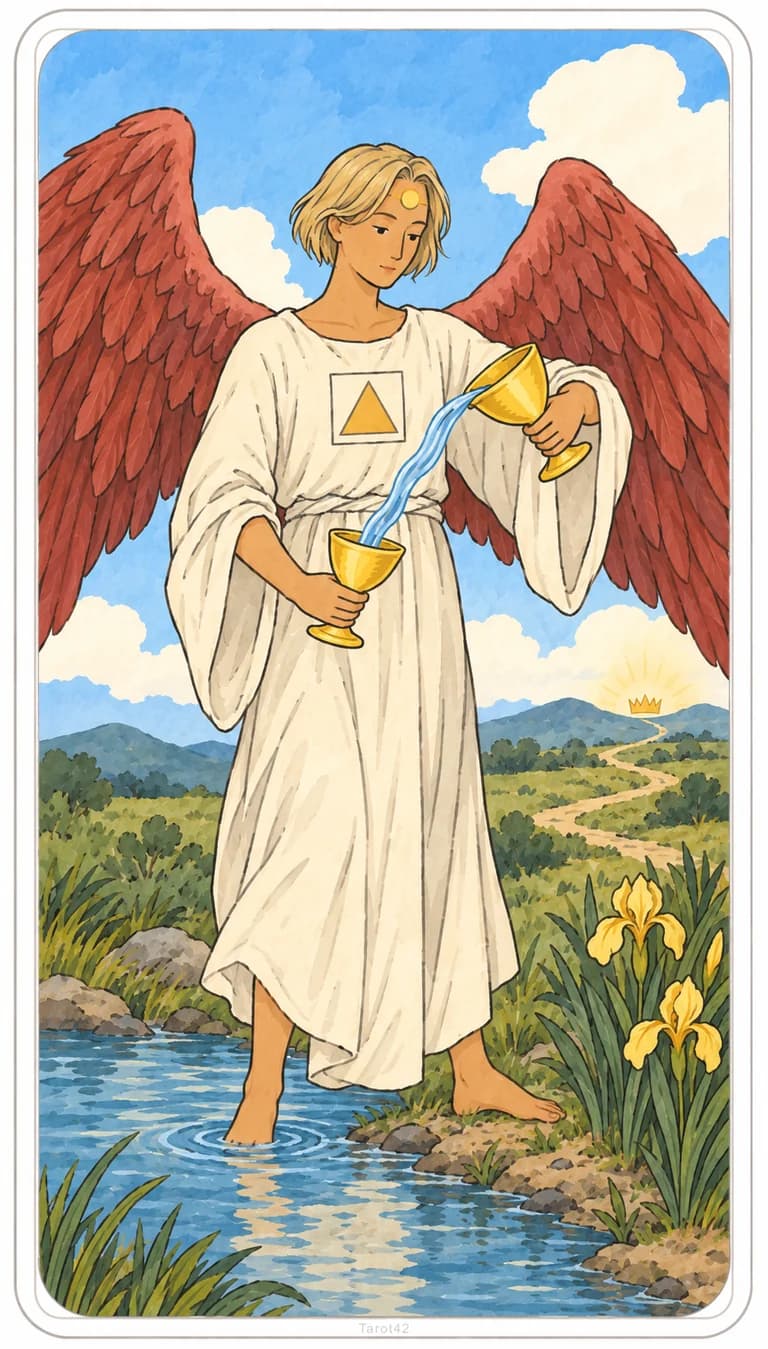
XIV · Temperance
Finding a livable mixture
On the new route, the traveler alternates between working until exhaustion and refusing to work at all. A patient companion pours water between two vessels, testing a mixture a little at a time. Neither vessel has to disappear for the mixture to change.
The traveler starts making smaller adjustments: a shorter working day, a regular meal, a conversation before resentment grows. Integration happens in these modest repetitions, not in one perfect afternoon.
The card’s lesson: Temperance suggests moderation, integration, and finding a workable balance between different elements. The flow between two cups gives this continuing adjustment a simple, memorable shape.
A question to carry: Which small adjustment would make this sustainable?
Explore this card’s meaningsStage three · Learning to live with greater freedom
XV–XXI. Old attachments and false certainties become visible. Hope returns gradually, and completion means bringing experience back into ordinary life.
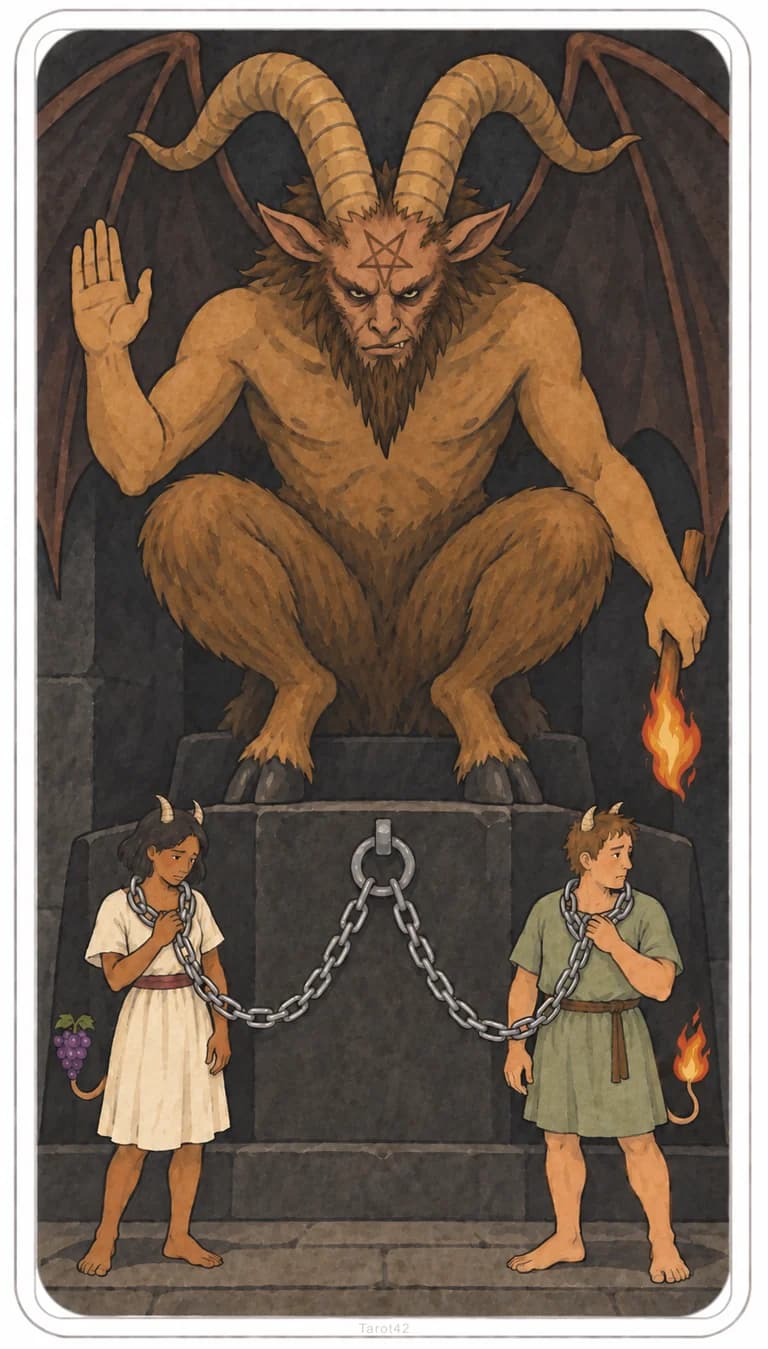
XV · The Devil
Recognizing the bargain that has become a chain
A host offers the traveler comfort on one condition: never question the arrangement. At first the price seems small. Over time, the traveler notices how often they give up a preference, a friendship, or a piece of honesty to keep that comfort.
The chain is not invisible anymore. Naming it does not instantly make leaving easy. It does make another conversation, a practical plan, or asking for help imaginable.
The card’s lesson: The Devil concerns binding patterns, attachment, and the pull of immediate gratification or power. The chains give a visible form to habits and bargains that gradually narrow a person’s choices.
A question to carry: What am I giving up to preserve this familiar comfort?
Explore this card’s meanings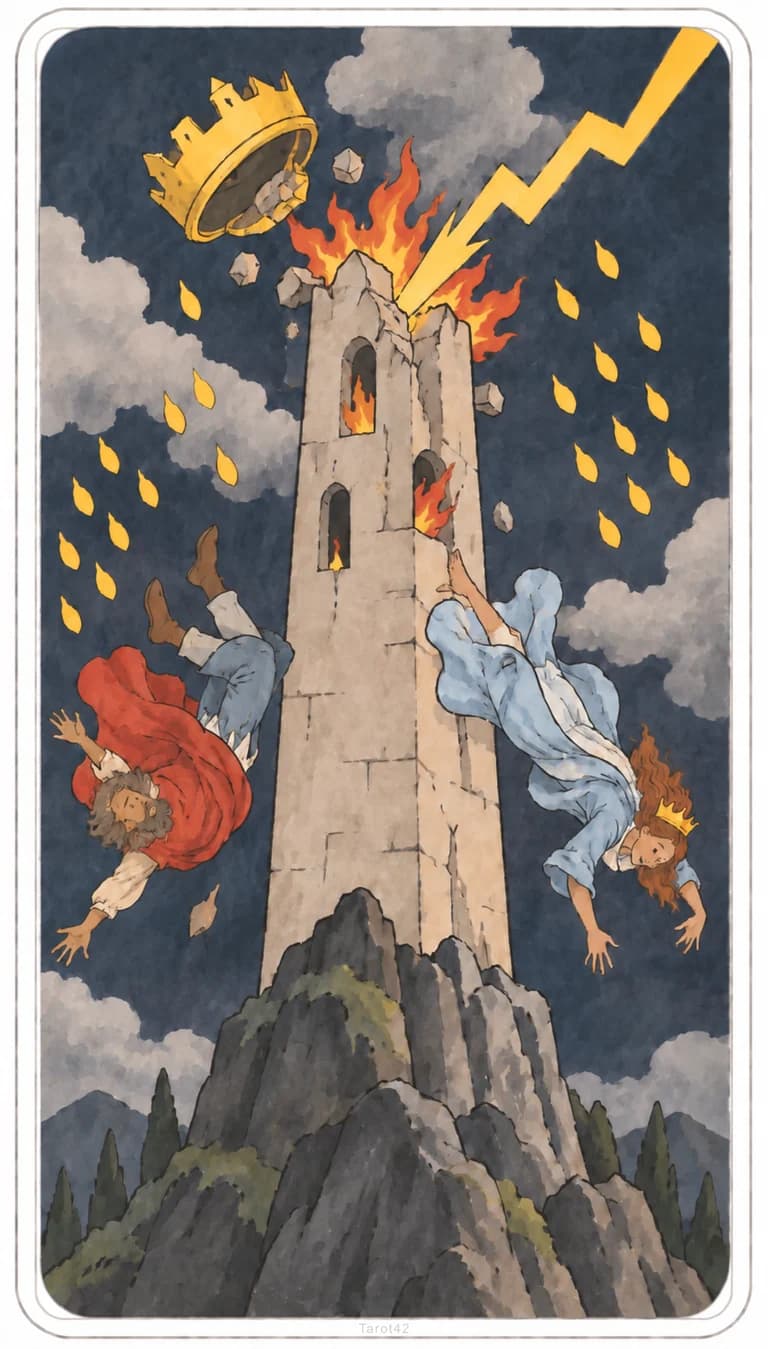
XVI · The Tower
When a structure cannot keep its promise
The traveler has come to rely on a tall building everyone calls permanent. During a storm, its neglected weaknesses become impossible to ignore. Leaving it is frightening, even when remaining inside is no longer sensible.
The traveler cannot yet call the disruption a gift. First come shelter, company, and practical repairs. Later there will be time to ask why the building’s reputation mattered more than what its walls were showing.
The card’s lesson: The Tower brings upheaval, revelation, and the failure of an unstable assumption or structure. The flash of lightning exposes, in a moment, what the apparently solid building can no longer contain.
A question to carry: What evidence no longer fits the story I have been relying on?
Explore this card’s meanings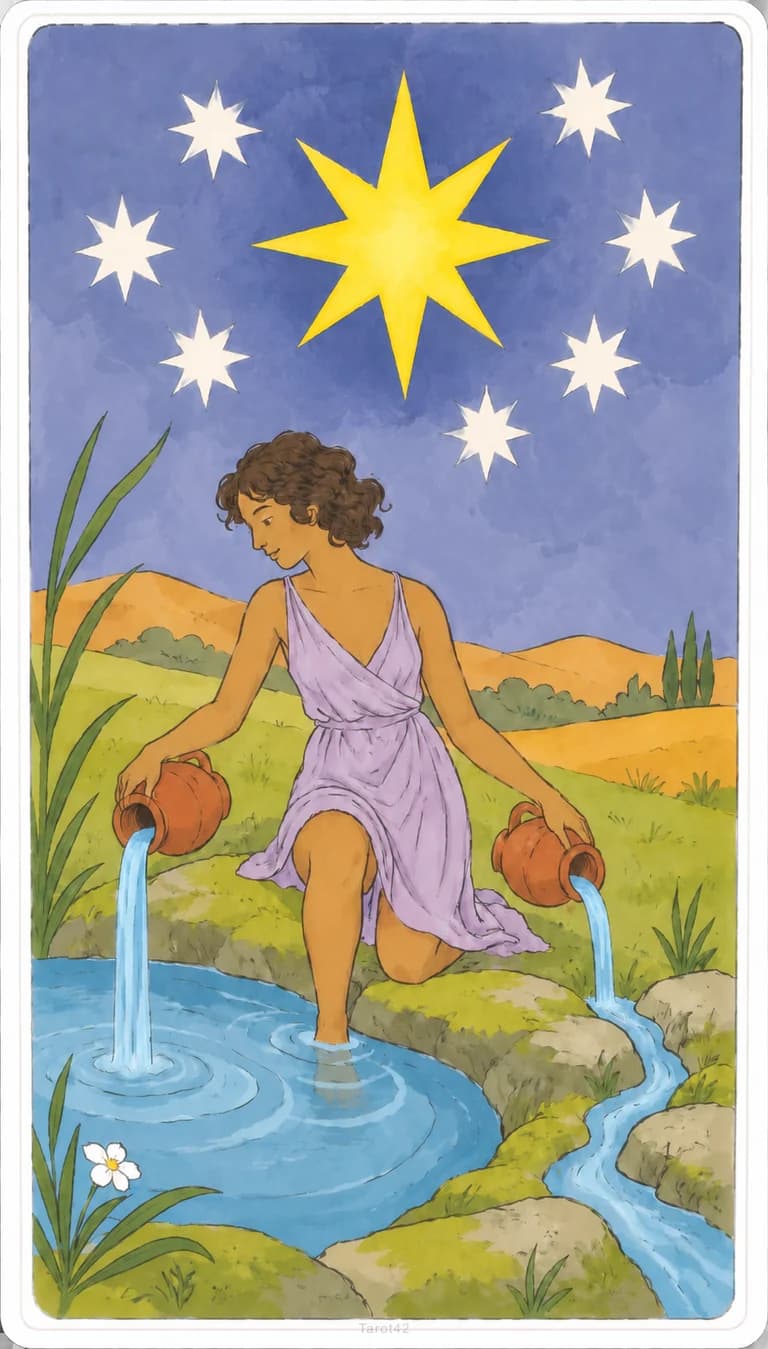
XVII · The Star
Hope without a guarantee
After the noise, there is water and a clear night. A woman pours from two vessels without trying to fill the whole valley at once. The traveler washes their hands, drinks, and notices that their breathing has slowed.
No grand promise arrives. A friend brings a blanket; a small task gets done. Hope returns as the ability to participate in tomorrow, even while its shape is uncertain.
The card’s lesson: The Star suggests hope, renewal, openness, and the return of trust. Water offered to both land and pool makes renewal feel generous, gradual, and connected to the living world.
A question to carry: What small, believable source of hope can I care for?
Explore this card’s meanings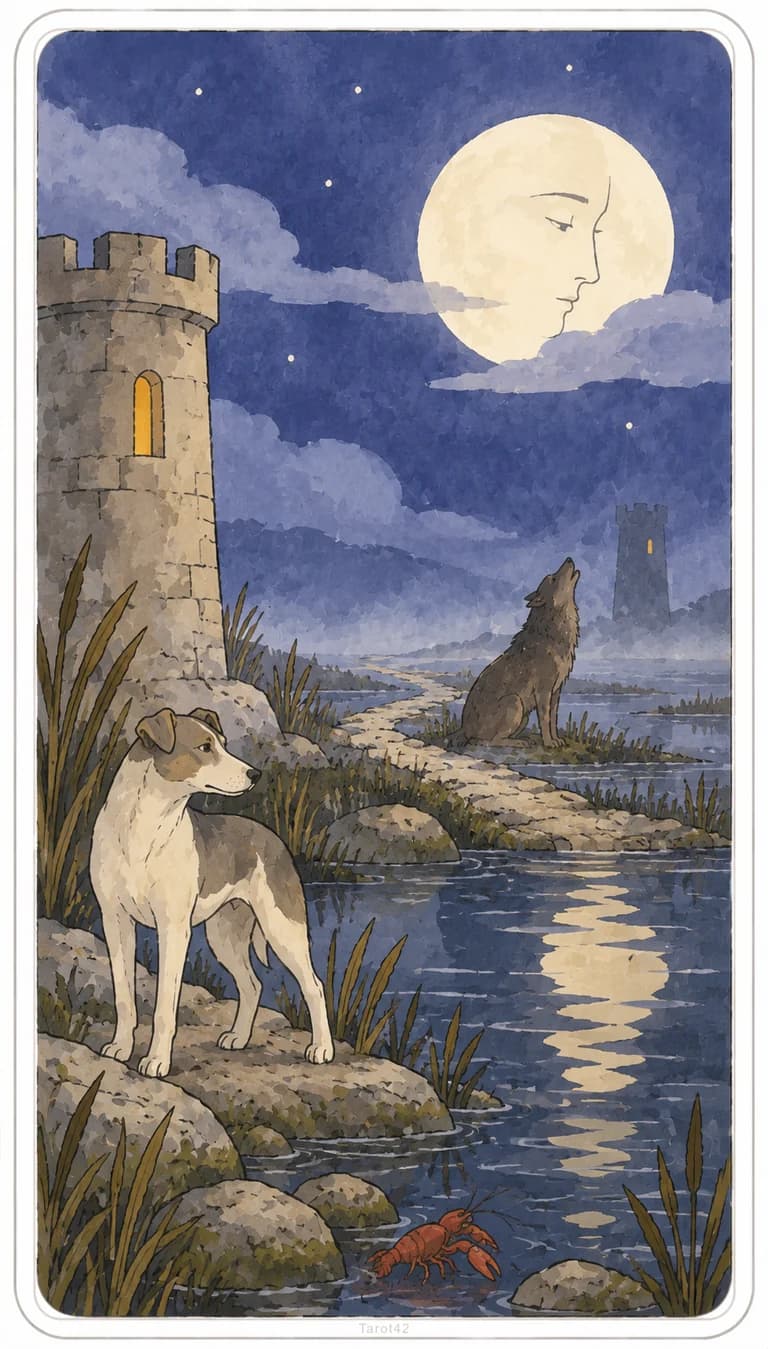
XVIII · The Moon
Walking without treating every shadow as a fact
Moonlight turns a familiar path strange. A shape beside the water looks threatening until it moves with the reeds. Farther on, another unease proves worth investigating. The traveler cannot sort every impression into certainty at once.
They slow down, check the ground, and wait to ask a question in daylight. Imagination is part of being human; it becomes troublesome when a vivid possibility is mistaken for something already known.
The card’s lesson: The Moon concerns ambiguity, dreams, instinct, and uncertainty. The path passing between the towers draws attention toward what is only partly visible, inviting curiosity alongside discernment.
A question to carry: What do I know, what am I imagining, and what could I check?
Explore this card’s meanings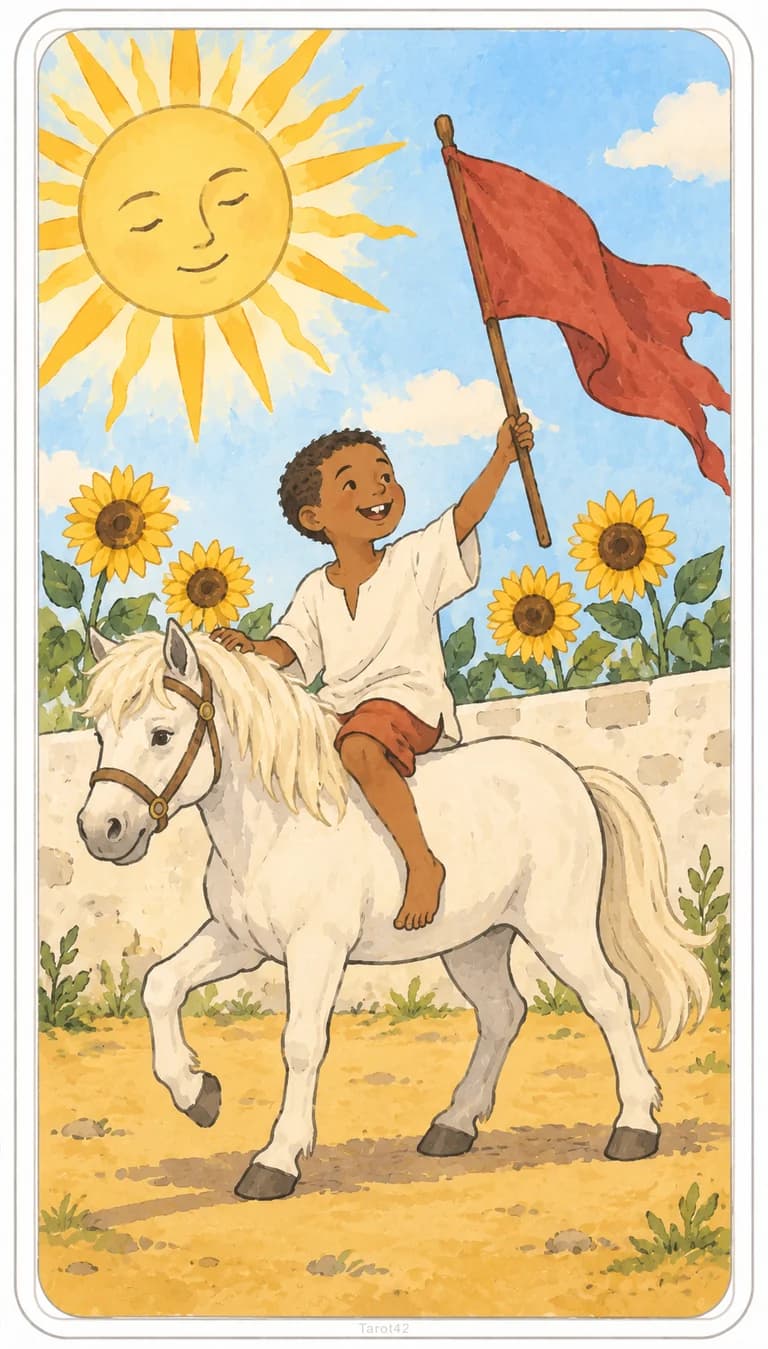
XIX · The Sun
The relief of seeing clearly
In the morning, the traveler finds the path less threatening than the night made it seem. In a courtyard, children are laughing at a small, ordinary game. No one asks them to explain why they deserve the pleasure of the day.
The traveler joins in. Joy is not a prize awarded only when every question is solved. For a while, seeing what is actually here is enough.
The card’s lesson: The Sun suggests clarity, vitality, warmth, and shared joy. The open scene and the child’s ease give this card a directness that feels different from the Moon’s uncertain light.
A question to carry: What is already clear or nourishing enough to enjoy?
Explore this card’s meanings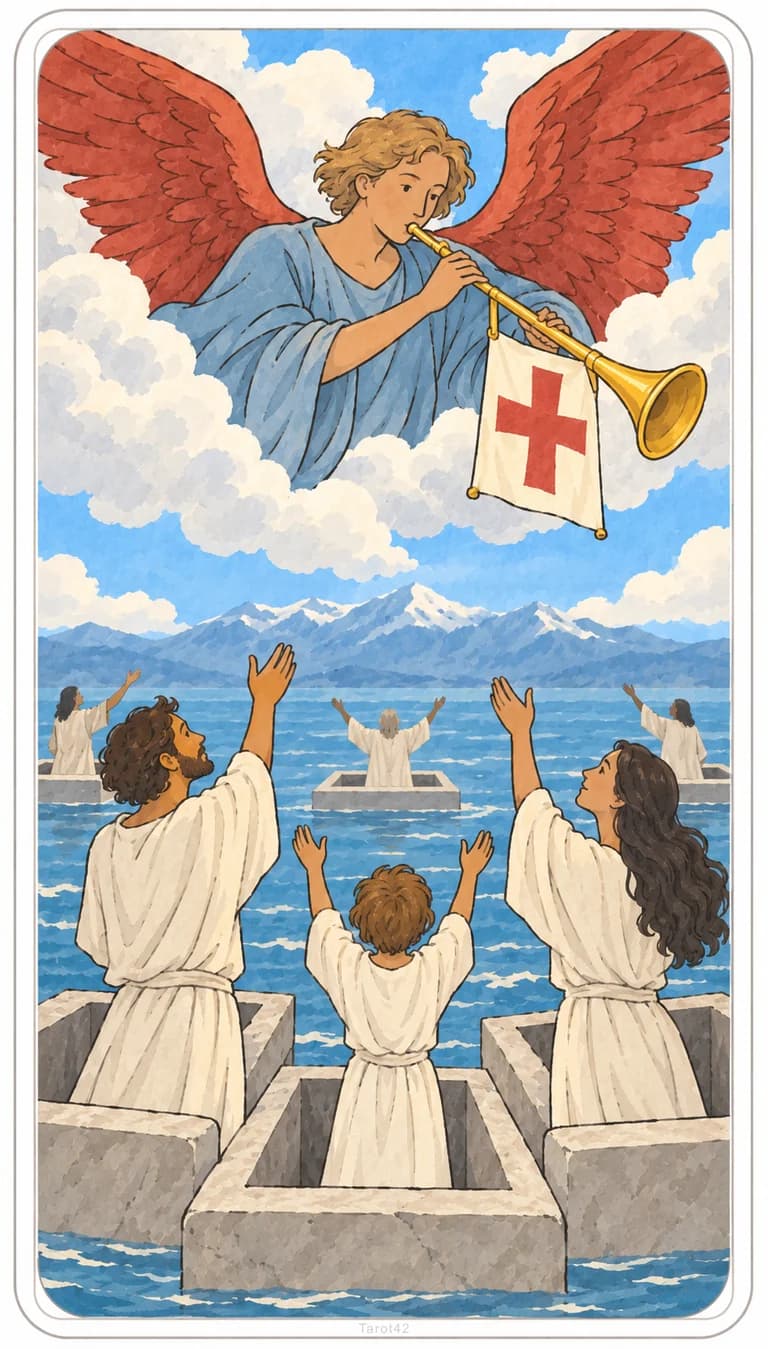
XX · Judgement
Answering a call in your own voice
A message arrives inviting the traveler to return and share what they have learned. They reread their old letters. Some are full of certainty they no longer feel; others contain a hope they had almost forgotten.
The call is not an order to become a different person overnight. It is an invitation to look back honestly, make amends where possible, and choose which part of the story deserves a new response.
The card’s lesson: Judgement concerns review, awakening, and responding to a deeper call. The trumpet and the rising figures make a picture of renewed awareness and a response that can change how life is lived.
A question to carry: What am I ready to acknowledge and answer differently?
Explore this card’s meanings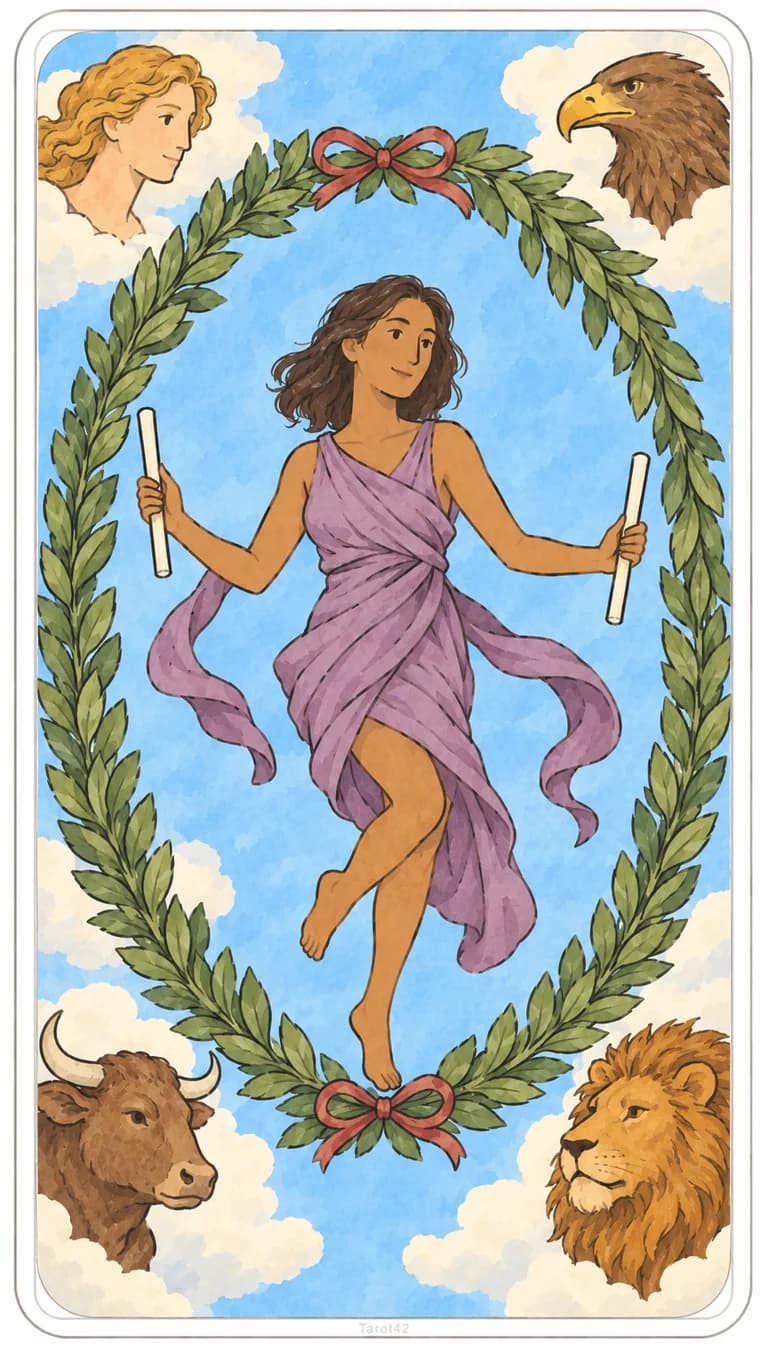
XXI · The World
Bringing the journey into daily life
The traveler returns with a worn bundle and a different idea of a map. The village has changed too. They repair a table, share a meal, keep a promise, and leave room in a conversation for something they do not know.
The journey has become useful because it can live in these acts. At the edge of the square, another path opens. The traveler is still capable of wonder; now they also know how to pack for the weather.
The card’s lesson: The World represents completion, integration, and belonging within a larger whole. Its surrounding wreath gathers a cycle into a whole while the central figure remains alive with movement.
A question to carry: How can what I have learned become part of how I live?
Explore this card’s meaningsThe Fool’s Journey at a glance
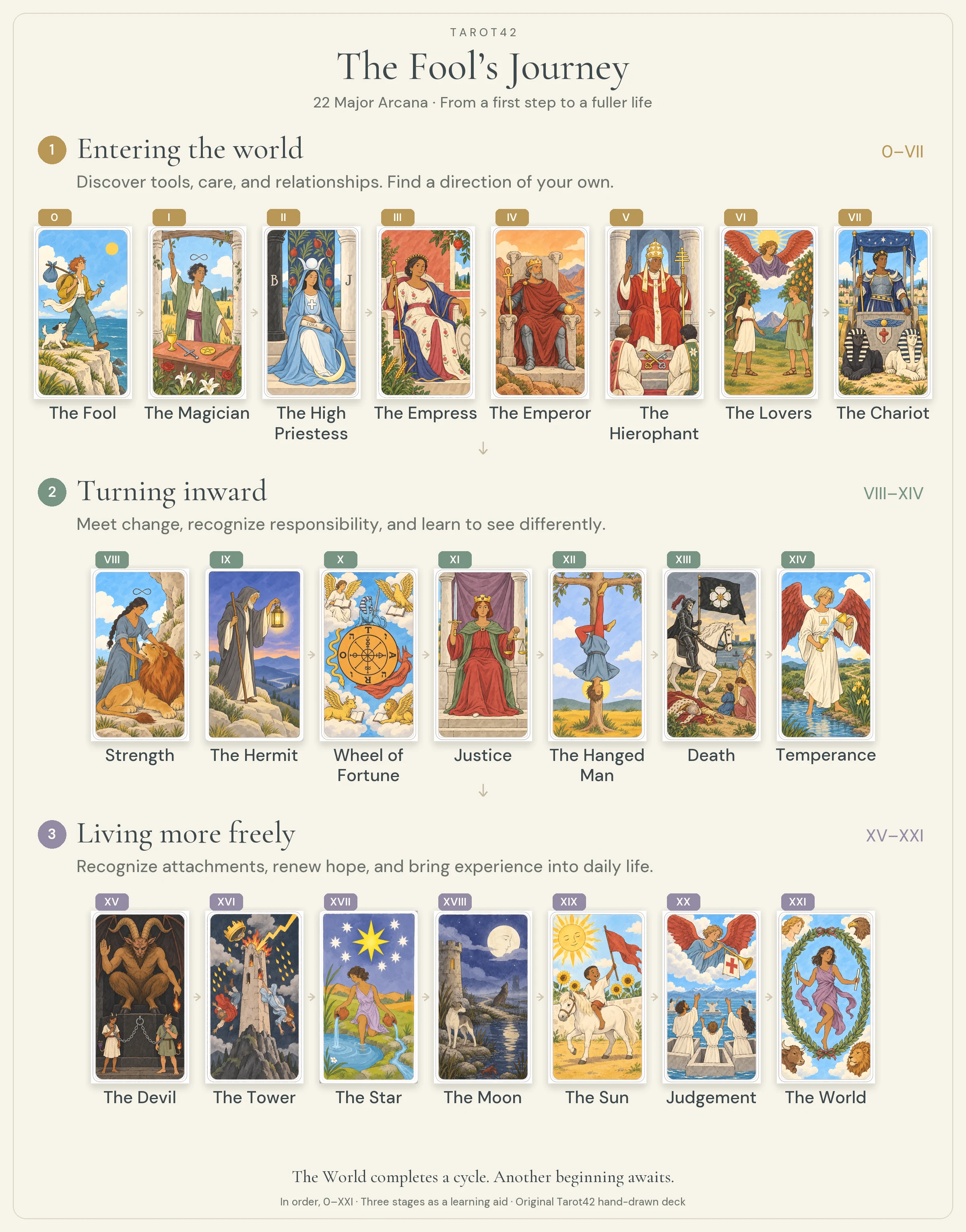
Use this map to revisit the story. Each card links back to its chapter; the short phrases are memory prompts, not a complete reading.
0–VII · Finding a direction
- 0The FoolBegin with curiosity; keep your eyes open.
- IThe MagicianTurn an intention into a practical first act.
- IIThe High PriestessListen before deciding that you understand.
- IIIThe EmpressMake room for care, creativity, and growth.
- IVThe EmperorBuild a structure that can hold what matters.
- VThe HierophantLearn from tradition without surrendering judgment.
- VIThe LoversChoose in a way that respects your values.
- VIIThe ChariotGive your energy a direction and stay responsive.
VIII–XIV · Turning inward
- VIIIStrengthMeet strong feelings with patience and courage.
- IXThe HermitFind enough quiet to recognize your own direction.
- XWheel of FortuneAdapt when circumstances turn.
- XIJusticeSee clearly and take responsibility for your part.
- XIIThe Hanged ManPause long enough for a different view.
- XIIIDeathLet an ending make room for a changed life.
- XIVTemperanceBring different needs into a workable balance.
XV–XXI · Living more freely
- XVThe DevilNotice what binds you and seek room to choose.
- XVIThe TowerFace what an unstable certainty has concealed.
- XVIIThe StarLet hope return in concrete, gentle ways.
- XVIIIThe MoonMake room for uncertainty; check your assumptions.
- XIXThe SunRecognize clarity, warmth, and ordinary joy.
- XXJudgementReview the past and respond with greater awareness.
- XXIThe WorldIntegrate what you have learned; remain open to beginning again.
How to learn tarot through the story
The sequence is most useful when it helps you notice a relationship between cards. You do not have to agree with every metaphor to learn from it.
Lay out the 22 Major Arcana in order
Put the Fool first and the World last. Look for changes in posture, setting, and mood. Notice the move from the Chariot’s forward drive to Strength’s patient presence, and from the Tower’s disruption to the Star’s openness.
Retell one transition in your own words
Choose two neighboring cards and describe what changes between them. The Hermit and the Wheel might connect a private search with circumstances that refuse to stay still. Invent a different link if it fits the images better.
Separate the picture, the meaning, and your situation
First name what you actually see. Then consider the card’s conventional themes. Only after that ask how they might relate to something real in your life. This helps prevent a compelling story from becoming a conclusion unsupported by facts.
Finish with one practical question
Rather than asking which stage you must be in, ask what kind of attention would help now. A Temperance question might be about a workable routine; a Justice question might be about an agreement you need to clarify.
A simple example: starting a creative project
Imagine publishing your first small collection of drawings. The Fool is the decision to try before you know the whole process. The Magician is choosing tools and making the first pages. The Lovers might be choosing work that expresses your values, rather than work you think everyone will approve.
Later, the Hanged Man could be a useful metaphor for a stalled draft that needs another view. Temperance might suggest a sustainable schedule, and the World a finished edition and what you learned from making it. These are ways of thinking about the project, not a prediction of events you are obliged to experience.
Where do the other 56 tarot cards fit?
The Fool’s Journey usually focuses on the 22 Major Arcana, while a standard tarot deck contains 78 cards. The other 56 are the Minor Arcana: four suits of 14, each with Ace through Ten and four court cards.
You can think of the Majors as broad themes and the Minors as more specific scenes. Wands often concerns initiative and effort; Cups, emotional experience and connection; Swords, thought and conflict; Pentacles, material life and practical care. These associations are interpretive tools, not exclusive rules.
For example, Strength beside the Nine of Wands might invite a story about patient courage after repeated effort. The Five of Cups and the Star might suggest grief alongside a small return of hope. Reading cards together does not mean forcing them into the numbered journey or treating a difficult card as a fixed ending.
Questions about the tarot cards story
Is the Fool’s Journey the original story behind tarot?
No single original plot is established for the whole deck. Tarot developed as a card game; the Fool’s Journey is a later way to connect the Major Arcana for learning and reflection. There are many retellings, including the original fictional story on this page.
Why does the Fool have the number 0?
In many modern decks, 0 suggests an open beginning and a figure that can stand both outside and within the sequence. Historical decks do not all number or position the Fool identically. Zero is not a statement that the card is less valuable than the others.
Does the journey include all 78 cards?
Usually it means the 22 Major Arcana, from 0 to XXI. The 56 Minor Arcana can enrich a story or a reading, but they are not normally the 22 stops in this particular framework.
Why are Strength and Justice numbered differently in some decks?
The order varies by tradition. This article follows Rider–Waite–Smith imagery, with Strength VIII and Justice XI. Many Marseille-style decks use Justice VIII and Strength XI. Check your own deck rather than assuming that one order fits every tarot tradition.
Do I have to go through the cards in order?
No. The sequence is a learning structure, not a timetable for life or an instruction for shuffling. In a reading, cards can appear in any order, and a familiar theme can return without meaning that you have failed a lesson.
Do Death, the Devil, and the Tower predict something terrible?
Their themes can be difficult, but a card is not evidence that a frightening event will happen. Here they explore endings, attachment, and upheaval. Keep the actual circumstances in view, and use the images to ask clearer questions rather than to announce a certain future.
Sources and further reading
Our story, chapter reflections, and illustrations are original. These references distinguish the learning framework, historical evidence, and traditional card symbolism; they are not the source of a translated narrative.