Written and illustrated by Tarot42 · Published
These cards often bring everyday situations into focus: how a project is moving, what a relationship needs, which thoughts keep returning, or how to manage the time and resources you have.
To begin, learn the four suits, then look at the number or figure, and return to the image and your question. If you want to look up a particular card, go to the complete Minor Arcana card list below.
The four Minor Arcana suits
The suits give you a starting point. These are common symbolic associations; a real situation often involves several of them at once.
| Suit | Common element | Areas of everyday life | A question to begin with |
|---|---|---|---|
| Wands | Fire | Enthusiasm, creativity, action, competition and effort | What do I want to do, and where am I putting my energy? |
| Cups | Water | Feelings, closeness, friendship, loss and belonging | What matters to me, and what response am I hoping for? |
| Swords | Air | Thoughts, communication, judgment, disagreement and uncertainty | What do I know, and what am I still assuming? |
| Pentacles | Earth | Work, time, money, daily arrangements and practice | What resources do I have, and how can I keep this going? |
A work question can bring up Cups. You might be thinking about trust between colleagues, or whether you still enjoy the work. A relationship question can involve Pentacles: shared time, expenses and responsibilities shape life together too.
The suit offers an angle. The image and your question help you decide what to explore.
Major vs Minor Arcana
| Comparison | Minor Arcana | Major Arcana |
|---|---|---|
| Number of cards | 56 | 22 |
| Structure | Four suits of 14 cards each | A sequence usually numbered 0 to 21 |
| Common reading focus | Immediate feelings, actions, relationships and practical arrangements | Broader themes of growth, choice and change |
Both can contribute to the same reading. The Lovers might draw attention to choice and shared intentions; the Three of Pentacles beside it can bring that theme into the way people divide tasks, communicate and make something together.
“Minor” does not mean unimportant. The distinction alone cannot tell you how long something will last or whether you can change it. Larger themes also take shape through everyday choices.
For the other part of the deck, explore the Fool’s Journey through the Major Arcana.
How to read the numbered cards
Each suit runs from Ace to Ten. Numbers can provide memory cues and help you compare cards across suits.
| Rank | Themes to notice | Look a little further |
|---|---|---|
| Ace | A beginning, opportunity or emerging feeling | What is taking shape, and what would help it develop? |
| Two | A relationship, choice or balancing act | Are things coming together, being weighed up or held at a standstill? |
| Three | Communication, participation and development | Who is involved, and how are they connected? |
| Four | Stability, staying put, protection and rest | Is the arrangement supportive, or has it become restrictive? |
| Five | Disagreement, loss, tension and change | What has happened, and what needs care? |
| Six | Response, adjustment, support and transition | What helps someone find their footing again? |
| Seven | Assessment, attempts, persistence and selection | What still needs judgment, and what is worth keeping? |
| Eight | Sustained effort, movement, departure or restriction | What is actually happening in this image? |
| Nine | The satisfaction or pressure of accumulated experience | What has been gained, enjoyed or carried this far? |
| Ten | A result, burden or completion | What has taken shape, and what cannot continue as before? |
Use the table to help you remember. When reading a particular card, look at what its figure is doing and which part of life the suit brings into view.
Why the four Eights mean different things
The image descriptions here refer to Rider–Waite–Smith imagery. Other decks may show different scenes; compare your own cards and their guidebook too. The examples pictured are from Tarot42’s original illustrated deck.
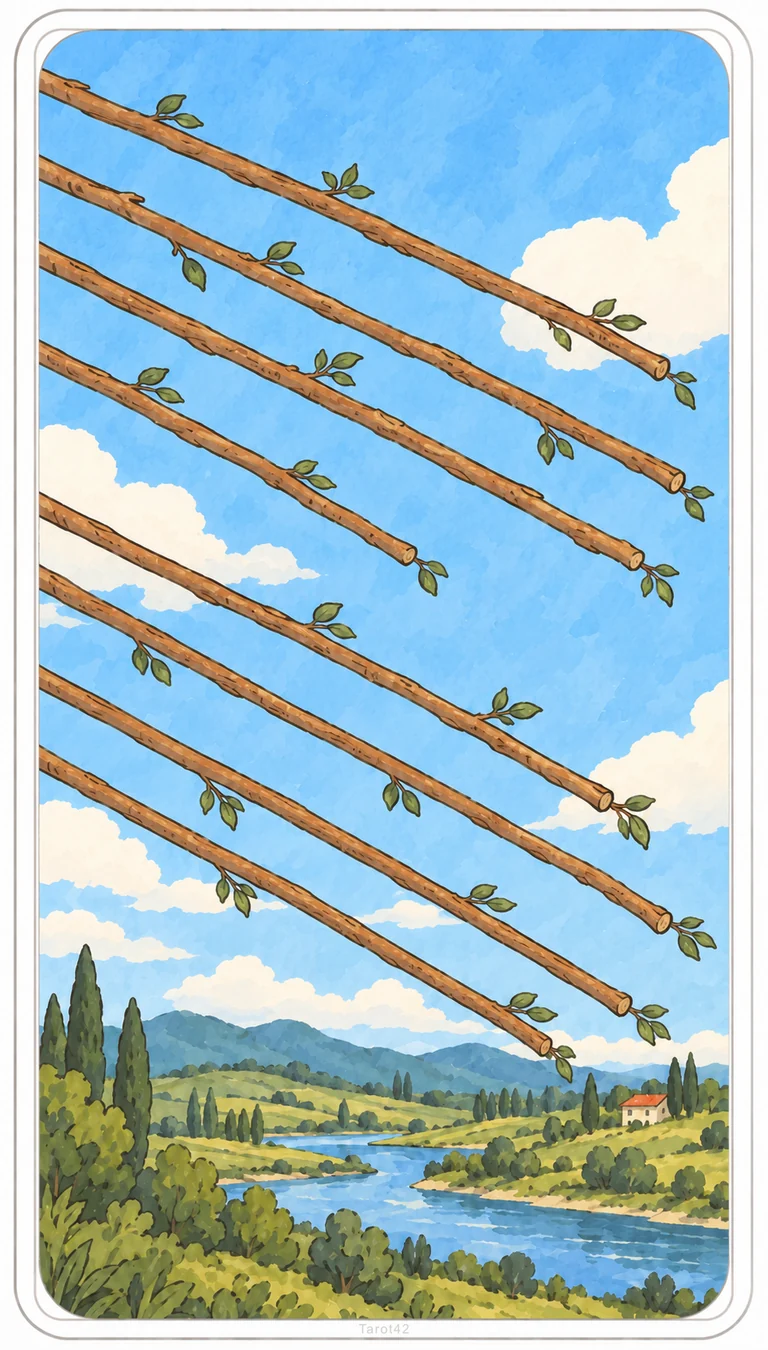
Eight of Wands: eight wands travel diagonally through the air. Their direction and speed suggest messages, movement and events gathering pace.
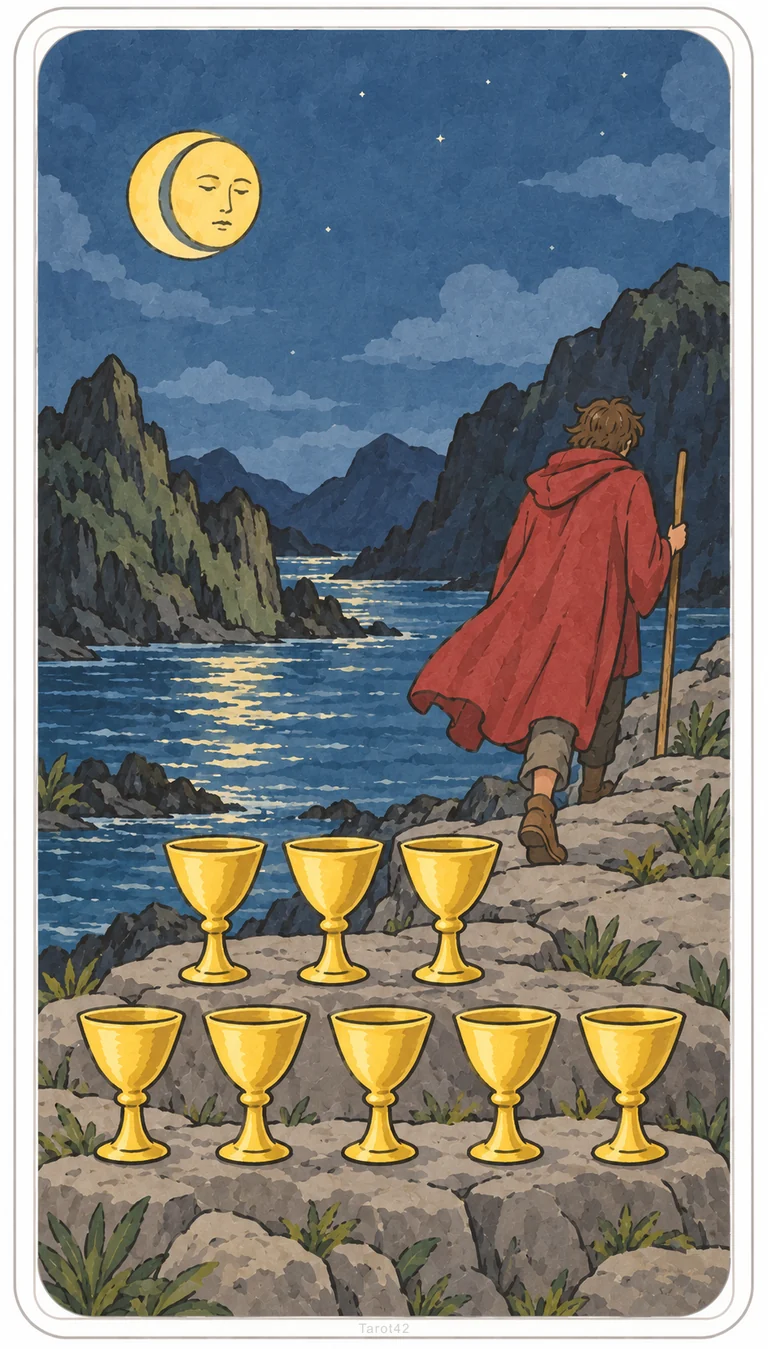
Eight of Cups: a figure turns away from eight cups and walks toward the distance. The scene draws attention to leaving, weariness and whether an earlier commitment still meets a deeper need.
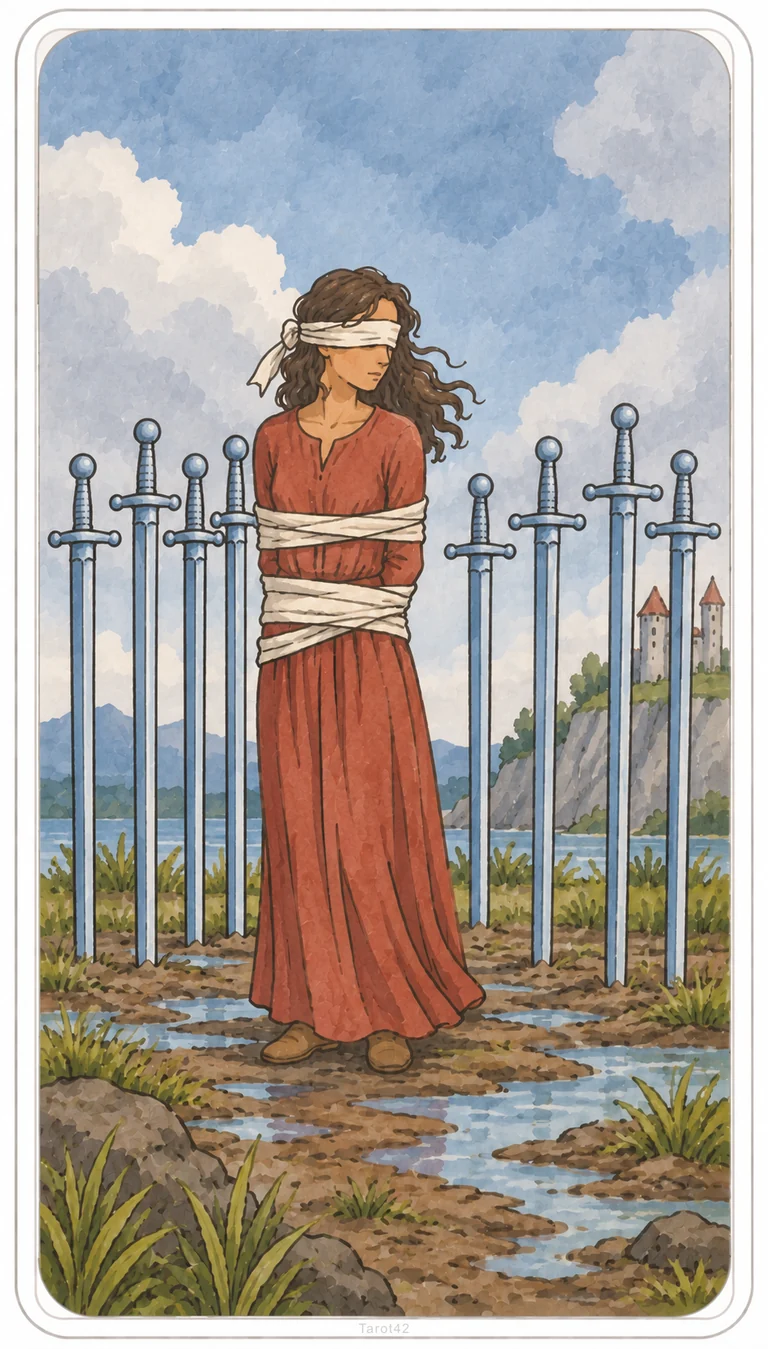
Eight of Swords: a blindfolded, bound figure stands among swords. This brings restriction and helplessness into view. Ask what is missing: information, permission, resources or support. Seeing a gap between the swords does not mean someone can immediately walk out.
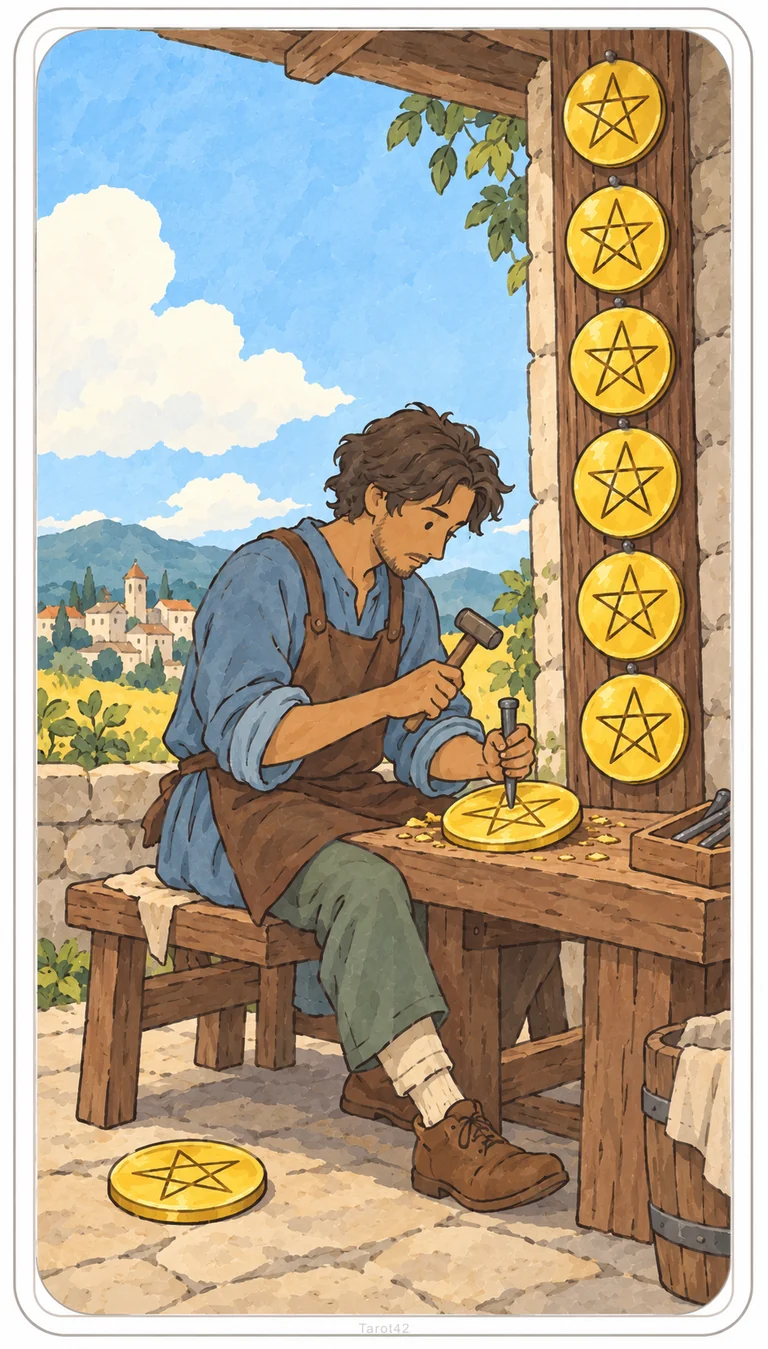
Eight of Pentacles: a seated craftsperson works on a pentacle, with finished pieces nearby. Here, effort is concrete: repeating a skill, noticing details and improving the work in front of you.
If you only remember “Eight means movement,” you can miss these differences. The number helps you recall a group; the image gives each card its own meaning.
Understanding the court cards
Four court cards in each suit make 16 in total. A court card can suggest a person, your own attitude, a role you are taking, or an approach worth trying.
| Court card | Common ways of expressing the suit | With Pentacles, for example |
|---|---|---|
| Page | Curiosity, learning, observation and first attempts | Discovering a skill and being willing to practice |
| Knight | Acting and pursuing something, sometimes too intensely | Working through steps and following through on a commitment |
| Queen | Attentiveness, care and a mature response | Using available resources to support daily needs |
| King | Oversight, judgment, responsibility and leadership | Managing resources so results and support can last |
With the Queen of Swords, you might first ask whether a situation needs clearer communication and boundaries. If your question concerns a person, consider whether those qualities fit them.
The titles need not correspond to someone’s literal age, gender or job. Someone experienced in one field can still meet a new subject with the curiosity of a Page.
Bring the card back to your question
Try this sequence when reading a Minor Arcana card:
- Name the question. Know what you want to explore. “How can I move my portfolio forward this week?” is easier to connect to real circumstances than “What will my future be?”
- Describe the image. What is the figure doing or facing? What is held, left behind, blocked or repeatedly made? Start with what you can see.
- Connect meaning and position. Use the suit, rank or figure to help you interpret, then ask whether this position describes the situation, an obstacle or advice.
- Keep one thing you can check or try. You might clarify a requirement, have a conversation or finish a small task. Return to what actually happens afterward.
The same card can take a different emphasis in another position. The Four of Pentacles as a situation might describe wanting to protect an existing arrangement. As an obstacle, it could prompt you to examine whether fear of change is making adjustment difficult. As advice, it might suggest preserving the time and resources you need.
A complete three-card reading example
Imagine you are working while preparing a portfolio. Several weeks have passed. Your folder is full of references, but very little finished work. You ask: How can I move my portfolio forward this week?
Before drawing, choose the positions Situation, Obstacle and Advice. The following three upright cards are deliberately selected for a teaching example.
| Position | Example card | What to notice first |
|---|---|---|
| Situation | Two of Pentacles | Several commitments needing repeated adjustment |
| Obstacle | Eight of Swords | Real difficulties, and limits that may need examining separately |
| Advice | Eight of Pentacles | One specific piece of work you can practice and improve |
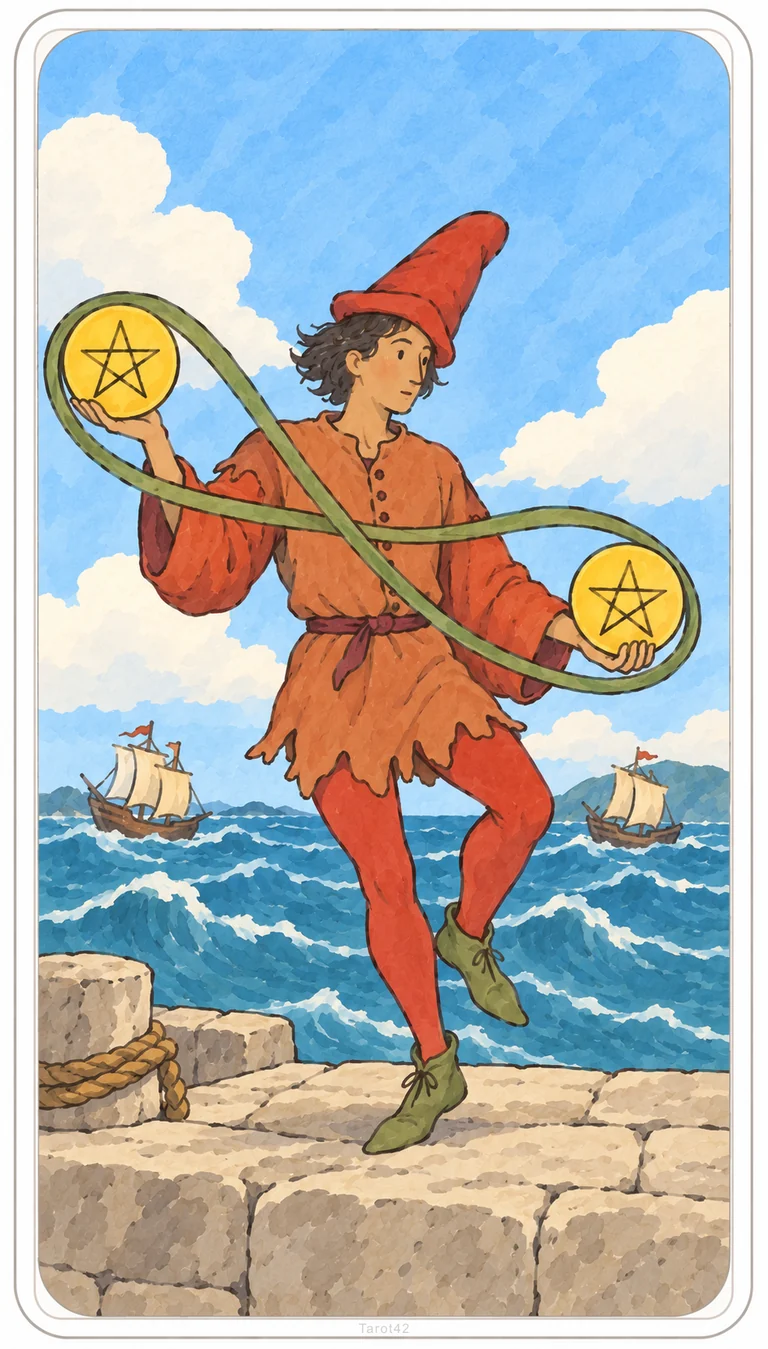
Start with the situation. The Two of Pentacles shows a figure juggling two pentacles while ships rise and fall on the waves behind. For this question, consider how work and the portfolio compete for the same hours. Perhaps you planned to study every evening without leaving room for overtime or rest.
Then read the obstacle. The Eight of Swords makes the feeling of being stuck visible. Separate the difficulties: lacking software is a resource issue; not knowing an application’s requirements is an information issue. “If the work is imperfect, it will definitely be rejected” contains an assumption you have not checked. Each difficulty calls for a different kind of help.
Finally, read the advice. The Eight of Pentacles returns attention to making something. Alongside the other cards, it might prompt you to choose one project, clarify what it needs to demonstrate, reserve a usable stretch of time and complete one part. At your next session, examine what needs revising and keep practicing.
Together, the cards give you things to examine: your schedule, the specific barriers and what you will make next. They do not guarantee an application outcome. Requirements, finished work and real feedback let you check whether this interpretation helps.
For more practice connecting positions, read the three-card tarot spread guide.
Reading Minor Arcana reversals
Begin with what the card usually draws attention to, then consider how that theme is appearing in the situation.
The Eight of Pentacles often concerns attentive practice. Reversed, it might prompt you to notice mechanical repetition, difficulty concentrating, or perfectionism over one detail that prevents the whole piece from being finished. Your circumstances help you distinguish between them.
Some readers use reversals to explore inward feelings, something not yet expressed, or a quality taken too far. Choose an approach you understand before reading and use it consistently so you can review what you meant.
You can also begin with upright cards only. Difficulty, loss and hesitation are already present in upright meanings; the card does not have to be upside down for a reading to address them.
All 56 Minor Arcana cards and meanings
These short summaries describe common upright themes. Follow a card’s name for its image, upright and reversed meanings, and interpretations across different parts of life.
The 14 Wands cards
| Card | Common themes |
|---|---|
| Ace of Wands | Emerging interest, inspiration, a first attempt |
| Two of Wands | Direction, weighing options, preparing to expand |
| Three of Wands | Development, cooperation, watching for a response |
| Four of Wands | Celebration, gathering, a milestone |
| Five of Wands | Disagreement, competition, everyday friction |
| Six of Wands | Achievement, recognition, renewed confidence |
| Seven of Wands | Standing your ground, making room, boundaries |
| Eight of Wands | Messages, swift action, gathering pace |
| Nine of Wands | Resilience, experience, cautious protection |
| Ten of Wands | Too much responsibility, burden, strain |
| Page of Wands | Curiosity, exploration, expressing a new idea |
| Knight of Wands | Enthusiasm, action, adventure |
| Queen of Wands | Confidence, warmth, an encouraging presence |
| King of Wands | Vision, creativity, leading through action |
The 14 Cups cards
| Card | Common themes |
|---|---|
| Ace of Cups | New feelings, being moved, opening up |
| Two of Cups | Attraction, friendship, one-to-one cooperation |
| Three of Cups | Friendship, sharing, connection in a group |
| Four of Cups | Disengagement, weariness, noticing your needs |
| Five of Cups | Loss, regret, acknowledging sadness |
| Six of Cups | Memories, familiar ties, simple pleasures |
| Seven of Cups | Wishes, imagination, too many options |
| Eight of Cups | Weariness, leaving, a search for meaning |
| Nine of Cups | Satisfaction, enjoyment, a wish fulfilled |
| Ten of Cups | Belonging, life together, shared happiness |
| Page of Cups | Sensitivity, curiosity, expressing a feeling |
| Knight of Cups | An invitation, expression, reaching out |
| Queen of Cups | Care, empathy, emotional attentiveness |
| King of Cups | Acceptance, gentle judgment, a mature response |
The 14 Swords cards
| Card | Common themes |
|---|---|
| Ace of Swords | Clear understanding, honest expression, a new idea |
| Two of Swords | Indecision, a standstill, a delayed response |
| Three of Swords | Heartache, separation, facing disappointment |
| Four of Swords | Rest, solitude, quiet preparation |
| Five of Swords | Conflict, winning and losing, the cost to a relationship |
| Six of Swords | Transition, adjustment, accepting help |
| Seven of Swords | Strategy, independent action, withholding something |
| Eight of Swords | Restriction, uncertainty, helplessness |
| Nine of Swords | Worry, self-blame, recurring thoughts |
| Ten of Swords | A painful ending, exhaustion, an approach reaching its limit |
| Page of Swords | Curiosity, observation, asking questions |
| Knight of Swords | Directness, speed, determination |
| Queen of Swords | Independence, honesty, mature discernment |
| King of Swords | Analysis, fair principles, a clear decision |
The 14 Pentacles cards
| Card | Common themes |
|---|---|
| Ace of Pentacles | A tangible opportunity, resources, a new foundation |
| Two of Pentacles | Balancing commitments, adjustment, flexibility |
| Three of Pentacles | Skill, cooperation, making something together |
| Four of Pentacles | Holding on, protection, seeking security |
| Five of Pentacles | Limited resources, hardship, feeling excluded |
| Six of Pentacles | Sharing, assistance, distribution of resources |
| Seven of Pentacles | Long-term effort, waiting, reviewing progress |
| Eight of Pentacles | Practice, skill, attentive work |
| Nine of Pentacles | Independence, accumulated effort, enjoying results |
| Ten of Pentacles | A lasting foundation, inheritance, shared life |
| Page of Pentacles | Learning, practice, building a foundation |
| Knight of Pentacles | Patience, responsibility, following through |
| Queen of Pentacles | Practical care, resourcefulness, daily stability |
| King of Pentacles | Resource management, practical ability, reliable results |
Start practicing with one card
Choose a small, familiar question and draw one card. Write one sentence describing the image, then note how you think it connects to the question. Later that day, record what actually happened and whether your interpretation needs adjusting.
Next time, put the four cards of one rank together and compare their figures, actions and situations. Then follow a suit from Ace to Ten, noticing both connections and differences. Alternating between these approaches can make the cards easier to remember than a string of keywords.
You can also try Daily Tarot, reading the positions Energy, Focus and Release as labelled on the page, and consult the card meanings library as you go.
Frequently asked questions
Are there 40 or 56 Minor Arcana cards?
There are 56: 40 numbered cards from Ace to Ten, plus 16 court cards. Court cards are part of the Minor Arcana.
Does the Ace count as one?
For ordering and introductory study, the Ace usually occupies the first position, followed by Two through Ten. It often introduces the suit’s potential or beginning; that does not guarantee a favorable outcome.
What does it mean if all three cards are Minor Arcana?
You can explore the reading through specific circumstances, feelings and actions, but the combination itself is fairly common. If you draw three cards uniformly at random, without replacement, from a complete 78-card deck, the chance that all three are Minor Arcana is about 36.4%. Their number alone does not tell you how important the situation is.
Can I practice with only the Minor Arcana?
Yes. You can use these 56 cards while learning suits and ranks, then combine them with the Major Arcana. Decide which cards and positions you will use before reading so your notes are easier to revisit.
Can I use this guide with other decks?
The number of cards and suit structure can help you get acquainted with a deck. Check its actual images when reading: some numbered cards show suit symbols without the scenes described here. Court titles, elemental associations and reading traditions may also differ. Your deck’s guidebook offers a more direct reference.
Sources and further reading
- The Met on the history and structure of tarot, for the structure of the suits, numbered cards and court cards.
- Joan Bunning’s Minor Arcana lesson, for further study of suits, ranks and figures.
- A. E. Waite’s description of the Eight of Pentacles, to compare the craftsperson and work in the image.
- Tarot42’s complete card meanings library, for individual images and upright and reversed interpretations.